Delta-wye transformer connections explained

A delta wye transformer has its primary windings connected end to end in a closed triangle (delta) and its secondary windings joined at a common neutral point (wye, or star). This is the most widely used three-phase distribution connection: the wye side provides an earthed neutral for 480Y/277 V or 400/230 V loads, while the delta side blocks zero-sequence current and triplen harmonics from reaching the supply network.
Key takeaways
- In a wye winding, line voltage is √3 times the winding voltage and line current equals winding current. In a delta winding, line voltage equals winding voltage and line current is √3 times winding current.
- Delta-wye gives a stable four-wire secondary, isolates earth faults between the two sides and shifts phase by 30°.
- Wye-wye passes zero-sequence current straight through, so it needs an earthed neutral on both sides and usually a five-limb or shell core.
- Delta-delta has no neutral but can keep running in open delta at 57.7% of bank capacity if one single-phase unit fails.
- High-leg delta and corner-grounded delta are legacy-style secondaries with specific marking, equipment and safety rules.
This article focuses on how the windings are physically connected and how each connection behaves in service. For vector group notation (Dyn11, Dyn1, YNd11) and clock numbers, see transformer vector groups explained.
What does a delta wye transformer diagram look like?
Each phase of a three-phase transformer has an HV winding and an LV winding on the same core limb. The connection is made by how the winding ends are joined.
        Delta primary                    Wye secondary
             H1                      X1        X2        X3
            /  \                       \       |       /
           /    \                       \      |      /
          /      \                       \     |     /
        H3 ------ H2                       \   |   /
                                              X0
   Each winding sits between            Windings join at X0,
   two line terminals                   the earthed neutral
- Delta (D or d): the end of winding A is connected to the start of winding B, B to C and C back to A. The line terminals are taken from the three junctions. There is no neutral point.
- Wye (Y or y): one end of each winding is joined to a common star point. The other ends are the line terminals. The star point can be brought out as a neutral terminal (X0 in IEEE marking, 2N in IEC marking) and earthed.
In North American marking, HV terminals are H1, H2, H3 and LV terminals X1, X2, X3, with X0 for the LV neutral.
How do voltage and current relate in delta and wye windings?
| Quantity | Wye winding | Delta winding |
|---|---|---|
| Line-to-line voltage | √3 × winding voltage | = winding voltage |
| Line current | = winding current | √3 × winding current |
| Neutral available | Yes, if brought out | No |
| Typical role | Supplies four-wire loads, provides an earth reference | Circulates triplen harmonics and zero-sequence current |
Worked example: a 1,500 kVA delta-wye unit, 13.8 kV to 480Y/277 V.
- Each HV winding sees the full 13.8 kV line voltage. HV line current is 1,500 / (√3 × 13.8) ≈ 62.8 A, and the current in each delta winding is 62.8 / √3 ≈ 36.2 A.
- Each LV winding sees 277 V. LV line and winding current are both 1,500 / (√3 × 0.48) ≈ 1,804 A.
- The turns ratio of each winding pair is 13,800 / 277 ≈ 49.8, not the line-voltage ratio of 28.75.
That last point matters when you check ratio test results: on delta-wye units the measured winding ratio differs from the nameplate line-voltage ratio by √3. Our transformer calculator handles the line current side.
Which 3 phase transformer connections are used, and why?
| Connection | LV neutral | Earth source for HV system | Zero-sequence passes through | Phase shift | Typical use | Main caution |
|---|---|---|---|---|---|---|
| Delta-wye | Yes | No | No | 30° | Distribution and industrial supplies, 480Y/277 V and 400/230 V | Ferroresonance risk on cable-fed units with single-pole switching |
| Wye-delta | No | Yes, if HV neutral earthed | No | 30° | Generator step-up, some subtransmission | Earthed HV star acts as a ground source on the HV network |
| Wye-wye (both earthed) | Yes | Only via the LV earthing | Yes | 0° | North American multi-earthed four-wire distribution, many pad-mounted units | Needs five-limb or shell core; LV earth faults appear on the HV side |
| Delta-delta | No (unless one winding is centre-tapped) | No | No | 0° | Three-wire industrial supplies, motor loads | Ungrounded system needs ground fault detection |
| Open delta (two units) | Optional, via centre tap | No | No | — | Rural three-phase from two single-phase units, temporary service | Only 57.7% of a three-unit bank's capacity |
Why is the delta wye transformer the default for distribution?
The delta y transformer separates the earthing of the two systems. A single-line-to-earth fault on the wye secondary draws current through one delta winding, which shows up on the HV side as current in two lines, not as an earth fault. The MV network's earthing method (solid, resistance or isolated) is unaffected, and LV earth faults do not trip MV earth fault relays.
This has a consequence for protection coordination. For a bolted single-line-to-earth fault on the LV side, the per-unit current in each of the two affected HV lines is only 1/√3 (about 58%) of the per-unit LV fault current. For a line-to-line LV fault, one HV line carries 2/√3 (about 115%) per unit. HV fuses and relays must be coordinated using these factors, or a primary fuse may be slower than expected for a secondary earth fault.
The delta winding also gives triplen harmonic currents from single-phase non-linear loads a path to circulate, so they do not flow into the MV network, although they still heat the transformer.
When is a wye wye transformer used?
The wye wye transformer, with both neutrals solidly earthed and interconnected, is standard on North American multi-earthed four-wire distribution systems. Pad-mounted units on these systems are often GrdY-GrdY. Advantages include no phase shift, simple paralleling with other wye-wye units and lower ferroresonance risk because each winding is referenced to earth.
The cautions are real, though:
- Zero-sequence current passes straight through, so LV earth faults and unbalance appear on the primary neutral.
- On a three-limb core, zero-sequence flux has no iron return path and closes through the tank, causing heating. Five-limb cores or shell-type cores avoid this.
- If the primary neutral is not earthed, triplen harmonic voltages and neutral shift distort the phase voltages. A tertiary delta winding is the classic cure in larger units.
Our pad-mounted transformer guide explains where GrdY-GrdY units fit.
When is a delta delta transformer used?
Delta-delta supplies a three-wire system with no neutral. It suits motor-dominated industrial loads and older plants. Two advantages stand out:
- If one unit in a bank of single-phase transformers fails, the remaining two can run in open delta at 57.7% of the full bank rating (86.6% of the two remaining units' combined rating).
- The system can be operated ungrounded, so a first earth fault does not trip supply. However, an ungrounded system is exposed to transient overvoltages and needs ground fault detection so the first fault is found and cleared before a second one occurs. The NEC requires ground detectors on ungrounded AC systems.
What are high-leg delta and corner grounded delta?
High-leg delta (four-wire delta) centre-taps one LV winding and earths the centre tap. This gives 120/240 V single-phase from that winding plus 240 V three-phase from all three. The third phase, the "high leg", sits at about 208 V to the neutral, so it must never supply 120 V loads. NEC 110.15 requires the high leg to be marked orange, and in panelboards it occupies the B-phase position. High-leg delta is common in older North American commercial services and is often supplied by an open-delta pair of pole-mounted units.
Corner grounded delta earths one phase conductor of a delta secondary instead of a neutral. It gives an earth reference on a three-wire system at low cost. Because the full line voltage appears between the two ungrounded phases and earth, equipment must be rated for it. Slash-rated breakers (for example 480Y/277 V) are not suitable, and the grounded phase must be clearly identified. New installations rarely choose it, but it still appears in existing plants.
For banks built from single-phase units, see our pole-mounted transformer guide and single-phase vs three-phase transformers.
What is ferroresonance and which connections are prone to it?
Ferroresonance is a non-linear oscillation between the transformer's magnetising inductance and the capacitance of the supply cable. It can produce high, distorted overvoltages. The classic trigger is single-pole switching or a single fuse operating on a lightly loaded, cable-fed transformer whose primary is delta or ungrounded wye. Mitigations include gang-operated three-pole switching, shorter cable runs, keeping some load connected during switching, or choosing an earthed-wye primary where the network allows.
How should you specify the connection?
- State the HV and LV connection, neutral terminals required and the earthing of each side.
- Give the vector group to the applicable standard, IEC 60076-1 or IEEE C57.12.00.
- Describe the loads: single-phase share, motors, non-linear loads.
- Identify any parallel operation, generation or inverters that will back-feed through the unit.
- Confirm switching and fusing arrangements on the primary.
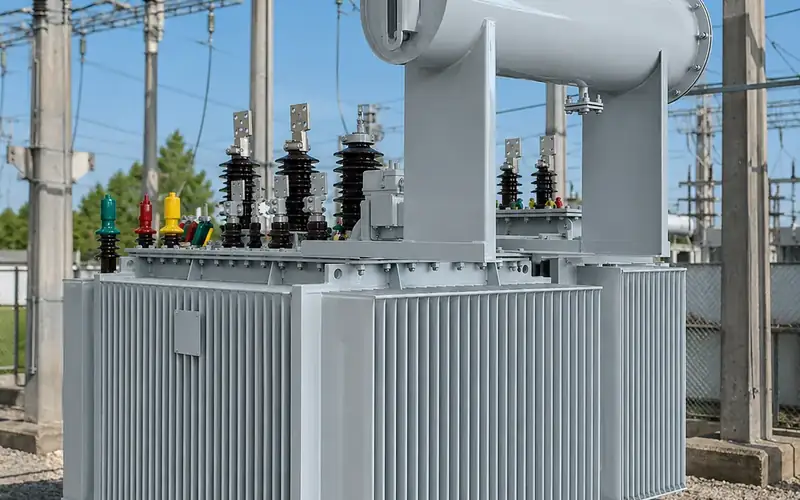
Our 35 kV to 480 V oil distribution transformers are built in delta-wye and other connections to suit the network.
Frequently asked questions
What is the difference between a delta wye and a wye delta transformer?
Delta-wye has the delta on the HV side and an earthed wye on the LV side, typical for distribution. Wye-delta puts the wye on the HV side, typical for generator step-up units, and provides no LV neutral.
Why does a delta wye transformer have a 30° phase shift?
Each LV winding sits on the same limb as one HV winding, which is connected between two lines. The LV phase-to-neutral voltage is therefore in phase with an HV line-to-line voltage, which is 30° away from the HV phase-to-neutral voltage.
Can a wye wye transformer have an ungrounded primary?
It can, but the neutral is unstable, triplen harmonic voltages distort the phase voltages and unbalanced loads shift the neutral. Earth both neutrals or add a tertiary delta winding.
What is the high leg on a delta system?
On a four-wire high-leg delta secondary, one phase is about 208 V to neutral instead of 120 V. It must be marked orange under the NEC and must not supply 120 V loads.
Is corner grounded delta still allowed?
It is permitted, but equipment must be rated for full line voltage to earth, slash-rated breakers cannot be used, and the grounded phase must be identified. Most new systems use an earthed-wye secondary instead.
Check your transformer connection
Send us your single-line diagram, network earthing, load mix and any existing transformers. Our engineers will recommend a connection and vector group and return a technical proposal. Contact our engineering team.