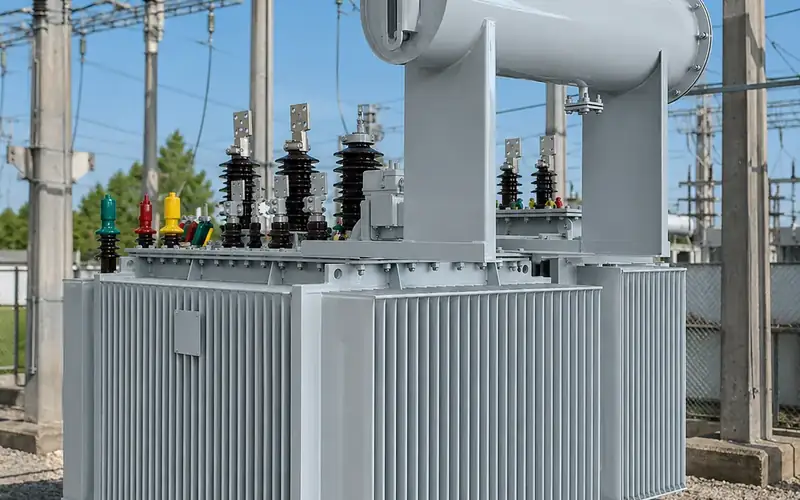
75 kVA transformer: full-load amps, voltages and uses

A 75 kVA transformer delivers 75,000 volt-amperes at full load. Single-phase at 240 V, that is 312.5 A; three-phase it is about 208 A at 208 V, 108 A at 400 V and 90 A at 480 V. It is a standard ANSI/IEEE rating used for pole-mounted service, small commercial buildings, workshops and 480 V to 208Y/120 V step-down in facilities.
Key takeaways
- Full-load current is I = kVA × 1000 / V for single-phase and I = kVA × 1000 / (√3 × V) for three-phase, with V as the line-to-line voltage.
- 75 kVA is a standard size in both the single-phase and three-phase ANSI/IEEE ladders. IEC-based markets more commonly use 50, 63 or 100 kVA nearby.
- The most common North American use is a 480 V delta to 208Y/120 V dry-type unit feeding lighting and receptacle panels.
- Size from the calculated demand, not the breaker rating, and allow for harmonics and growth.
- State phases, voltages, frequency, vector group, type (dry or oil) and installation in your enquiry.
How many amps is a 75 kVA transformer?
The full-load current depends only on the rated kVA, the voltage and whether the unit is single- or three-phase. The table below uses the formulas above; the values are rounded to one decimal place. You can check any other voltage with our transformer calculator.
| Configuration | Voltage (line-to-line) | Full-load current (A) |
|---|---|---|
| Single-phase, 120/240 V three-wire | 240 V | 312.5 |
| Single-phase | 277 V | 270.8 |
| Single-phase | 480 V | 156.3 |
| Single-phase primary (12.47Y/7.2 kV system) | 7.2 kV | 10.4 |
| Single-phase primary (13.2Y/7.62 kV system) | 7.62 kV | 9.8 |
| Three-phase, 208Y/120 V | 208 V | 208.2 |
| Three-phase | 380 V | 114.0 |
| Three-phase, 400/230 V | 400 V | 108.3 |
| Three-phase, 415/240 V | 415 V | 104.3 |
| Three-phase | 480 V | 90.2 |
| Three-phase | 600 V | 72.2 |
| Three-phase primary | 4.16 kV | 10.4 |
| Three-phase primary | 11 kV | 3.9 |
| Three-phase primary | 13.8 kV | 3.1 |
| Three-phase primary | 33 kV | 1.3 |
A note on 120/240 V single-phase
On a 120/240 V three-wire secondary, the 312.5 A rating applies to each line conductor. Each 120 V half of the winding is rated 37.5 kVA, so the transformer is fully loaded when both halves carry 312.5 A. Loading only one side to 625 A would overload that half of the winding.
Worked example
A 75 kVA three-phase transformer, 480 V primary, 208Y/120 V secondary:
- primary current = 75,000 / (1.732 × 480) ≈ 90.2 A
- secondary current = 75,000 / (1.732 × 208) ≈ 208.2 A
These are rated currents. Conductor and overcurrent protection sizing must follow the installation code that applies at the site (for example NEC Article 450 in the USA, or the national wiring rules elsewhere).
What is a 75 kVA transformer 480 to 208 used for?
In North American commercial and industrial buildings, power is often distributed at 480Y/277 V for motors, HVAC and lighting, while receptacles and small equipment need 120 V. A 75 kVA three-phase dry-type transformer, 480 V delta primary to 208Y/120 V secondary, is one of the most common ways to make that step. It typically feeds one or two 208Y/120 V panelboards for a floor or a section of a building.
Typical characteristics:
- Connection: delta primary, grounded wye secondary, so a neutral is available for 120 V loads and triplen harmonic currents circulate in the delta.
- Type: ventilated dry-type, wall-, floor- or trapeze-mounted indoors.
- Taps: usually a set of primary taps in 2.5 % steps to adjust secondary voltage.
- Harmonics: office loads with many electronic power supplies may call for a K-rated or harmonic-mitigating design.
For loads with variable-speed drives or rectifiers, the isolation transformer range from 30 kVA shows how input and output voltages are combined in dry-type designs.
Where else are 75 kVA transformers used?
| Application | Typical type | Typical voltages |
|---|---|---|
| Overhead residential or rural service | Single-phase pole-mounted, oil-filled | 7.2 to 14.4 kV primary to 120/240 V |
| Underground residential subdivision | Single-phase pad-mounted, oil-filled | 12.47 or 34.5 kV class primary to 120/240 V |
| Small commercial building or shop | Three-phase pad- or pole-mounted, or dry-type indoors | MV primary to 208Y/120 V or 480Y/277 V |
| Building step-down | Three-phase dry-type | 480 V to 208Y/120 V |
| Workshops, pumping stations, telecom sites | Three-phase oil or dry-type | 11 kV or 13.8 kV to 400/230 V or 480 V |
| Isolation for sensitive or non-linear loads | Dry-type isolation | 400 V or 480 V to 400 V or 208 V |
On overhead networks, single-phase units such as our 13.2 kV to 240 V or 480 V pole transformer in 50 and 75 kVA or the 10.5 kV to 400 V single-phase overhead transformer in 75 and 100 kVA are typical. A three-phase 75 kVA load on an overhead line can also be served by a bank of three 25 kVA single-phase units. For underground networks, see the 37.5 to 167 kVA single-phase pad-mounted transformer.
Is 75 kVA a standard transformer size?
Yes. In ANSI/IEEE practice (IEEE C57.12.00 and related product standards), the preferred kVA ratings are:
| Standard series | Ratings around 75 kVA |
|---|---|
| ANSI/IEEE single-phase | 25, 37.5, 50, 75, 100, 167 kVA |
| ANSI/IEEE three-phase | 30, 45, 75, 112.5, 150, 225 kVA |
| IEC practice (R10-based preferred values) | 50, 63, 80, 100, 125, 160 kVA, with 50, 100 and 160 kVA most common |
In IEC markets, a 75 kVA rating can still be built to order, but buyers often choose 63 or 100 kVA because those sizes are standard on national price lists and spare inventories. If you are working in a 400 V or 415 V network, check which ratings your utility or client accepts before fixing the size. The difference between the two families is explained in IEC 60076 vs IEEE C57 transformer standards.
Should you choose a 75 kVA 3 phase transformer or single-phase?
Choose by the supply and the load:
- Single-phase 75 kVA suits residential and light commercial services with 120/240 V loads, and overhead networks where only one phase is run to the customer.
- Three-phase 75 kVA suits sites with three-phase motors, HVAC compressors, commercial kitchens or 208Y/120 V and 400/230 V distribution.
A three-phase unit is smaller and lighter than three single-phase units of the same total rating, while a bank of single-phase units allows one unit to be replaced on its own. More detail is in single-phase vs three-phase transformers.
How do you check that 75 kVA is the right size?
- List the loads with their kW and power factor, and convert to kVA (kVA = kW / PF).
- Apply demand and diversity factors to get the realistic maximum demand.
- Add a growth margin, commonly 20 to 30 percent where expansion is expected.
- Check motor starting. A large direct-on-line motor can cause a voltage dip on a small transformer.
- Check harmonics. Heavy electronic loads increase heating; consider a K-rated or derated design.
- Select the next standard rating above the result, aiming for about 70 to 85 percent loading at normal peak.
For example, a demand of 52 kW at 0.9 power factor is about 58 kVA. With 25 percent growth margin, the design figure is about 72 kVA, so 75 kVA fits with little spare; if more growth is likely, 112.5 kVA would be the next three-phase ANSI size. The full method is in how to size a distribution transformer.
What should a 75 kVA transformer specification include?
- number of phases and frequency (50 or 60 Hz)
- primary and secondary voltages, with taps
- connection and vector group (for example delta-wye, Dyn11 or Dyn1)
- type: dry-type, oil-filled pole-mounted, or pad-mounted (loop or radial feed)
- indoor or outdoor, enclosure rating, ambient temperature and altitude
- impedance requirement, if any
- efficiency requirement (for example US DOE 10 CFR 431 for units in scope, or the national regulation in your market)
- sound level for indoor sites
- applicable standard (IEEE C57 or IEC 60076) and test list
Frequently asked questions
How many amps can a 75 kVA transformer handle at 480 V?
A three-phase 75 kVA transformer has a rated current of about 90.2 A at 480 V. A single-phase 75 kVA transformer with a 480 V winding has a rated current of 156.3 A.
What size is a 75 kVA transformer 480 to 208 secondary current?
The 208Y/120 V secondary of a 75 kVA three-phase transformer is rated about 208.2 A per phase. The secondary overcurrent device and conductors are then selected under the applicable installation code.
Can a 75 kVA transformer run a 75 kW load?
Only if the load power factor is 1.0, which is rare. At 0.85 power factor, 75 kW is about 88 kVA, which would overload a 75 kVA unit. Always convert kW to kVA first.
What is the next standard size above 75 kVA?
In the ANSI/IEEE three-phase series, it is 112.5 kVA; in the single-phase series, it is 100 kVA. In IEC practice, 100 kVA is the usual next step.
Is a 75 kVA transformer dry-type or oil-filled?
Both exist. Indoor building transformers at this size are usually ventilated dry-type, while pole- and pad-mounted utility units are oil-filled. The choice depends on location, fire rules and maintenance preferences.
Request a 75 kVA proposal
Send us your voltages, phases, load list or single-line diagram, and we will confirm the rating and return a technical proposal for a pole-mounted, pad-mounted or dry-type unit. Contact our engineering team.