Single-phase vs 3 phase transformers: how to choose

A single-phase transformer has one primary and one secondary winding on a single magnetic circuit and supplies single-phase loads. A 3 phase transformer has three pairs of windings on a common core and supplies three-phase networks and motors. For the same total kVA, one three-phase unit is smaller, lighter, cheaper and usually more efficient than three single-phase units, but banks of single-phase units still win on spares, transport and overhead distribution.
Key takeaways
- Single-phase transformers serve homes, small businesses and lighting loads, mostly as pole-mounted and pad-mounted distribution units.
- Three-phase transformers serve almost all commercial, industrial, utility and renewable plant loads.
- A three-limb core works because balanced three-phase fluxes sum to zero, so no separate return path is needed. That saves core steel.
- A three-phase bank of single-phase units is chosen when a spare is needed, when one large unit is too heavy to transport, or when the network grew from single-phase lines.
- Current formulas differ: I = kVA × 1000 / V for single-phase, I = kVA × 1000 / (√3 × V) for three-phase, using line-to-line voltage.
How does a single phase transformer work?
The primary winding is connected across one phase and neutral, or across two phases. Its alternating current creates flux in the core, which induces a voltage in the secondary winding in proportion to the turns ratio.
Two core arrangements are common:
- Core-type: windings are placed on two limbs of a rectangular core, or both windings are concentric on one limb of a wound core. Most pole and pad-mounted distribution units use wound cores.
- Shell-type: the windings sit on a central limb and the flux returns through two outer limbs.
Distribution units in North America often have a split secondary that gives 120/240 V three-wire service, with the centre tap earthed. In IEC markets, single-phase units typically deliver 230 V or 240 V.
A single phase power transformer is a larger unit, sometimes of hundreds of MVA, built as one phase of a three-phase bank. Very large generator step-up and extra-high-voltage substation transformers are built this way when a single three-phase unit would exceed transport limits. Single-phase units are also used for railway traction supplies.
How does a 3 phase transformer work?
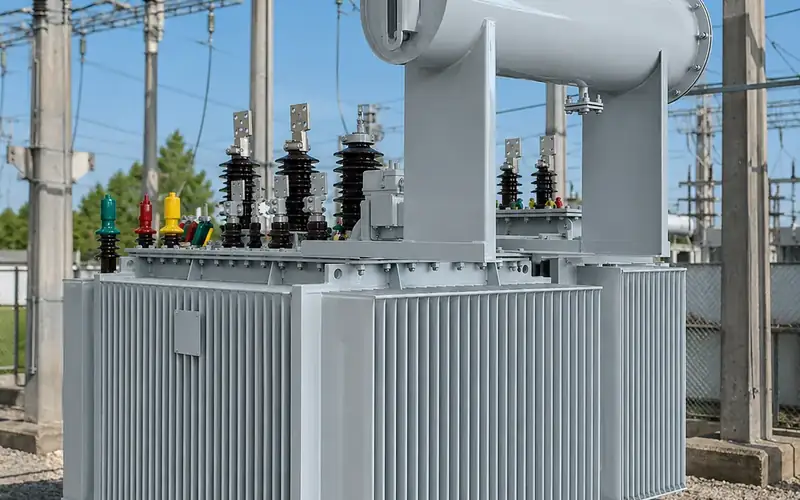
A three phase transformer places one HV and one LV winding on each of three core limbs. In a balanced system the three fluxes are 120° apart, so at every instant they add up to zero. The limbs act as each other's return path, and no extra iron is required.
Three main core designs are used:
| Core design | Description | Typical use |
|---|---|---|
| Three-limb core-type | Three wound limbs joined by top and bottom yokes | Most distribution and power transformers |
| Five-limb core-type | Two extra unwound outer limbs give a path for zero-sequence flux and allow lower yokes | Large units with transport height limits; wye-wye units with earthed neutrals |
| Shell-type | Windings enclosed by the core | Some large power transformers |
The three windings on each side can be connected in delta, wye or zigzag. Those choices set the phase shift, neutral availability and earth fault behaviour. Our article on delta-wye transformer connections covers them in detail.
Three phase transformer vs single phase transformer: what are the differences?
| Criterion | Single-phase transformer | Three-phase transformer |
|---|---|---|
| Windings | One primary, one secondary (secondary may be split) | Three primary and three secondary windings |
| Core | One magnetic circuit | Shared three-limb, five-limb or shell core |
| Typical ratings | 5 kVA to about 500 kVA in distribution; very large single units in EHV banks | 15 kVA to hundreds of MVA |
| Typical primary connection | Phase to neutral or phase to phase | Delta, wye or zigzag |
| Typical secondary | 120/240 V, 230 V, 240 V | 208Y/120 V, 400/230 V, 480Y/277 V, MV |
| Loads served | Homes, small shops, lighting, single-phase motors | Three-phase motors, industrial plants, buildings, inverters |
| Material and losses for the same kVA | Higher in total when three units are banked | Lower |
| Footprint for the same kVA | Larger as a bank | Smaller |
| Spare strategy | One spare covers a bank | Full spare unit needed |
| Common mounting | Pole, pad, platform | Pad, plinth, substation, indoor room |
How do you calculate current for each type?
Use the rated kVA and the rated voltage of the winding:
- Single-phase: I = kVA × 1000 / V
- Three-phase: I = kVA × 1000 / (√3 × V), where V is the line-to-line voltage.
| Transformer | Calculation | Full-load current |
|---|---|---|
| 50 kVA single-phase, 240 V | 50,000 / 240 | 208.3 A |
| 167 kVA single-phase, 240 V | 167,000 / 240 | 695.8 A |
| 75 kVA three-phase, 208 V | 75,000 / (1.732 × 208) | 208.2 A |
| 500 kVA three-phase, 400 V | 500,000 / (1.732 × 400) | 721.7 A |
| 1,500 kVA three-phase, 480 V | 1,500,000 / (1.732 × 480) | 1,804 A |
Notice that a 75 kVA three-phase unit at 208 V and a 50 kVA single-phase unit at 240 V have almost the same line current. The three-phase unit delivers more power because it uses three conductors. Our transformer calculator does these conversions and lists standard sizes, and our guide on how to size a distribution transformer covers load and growth margins.
When does a three-phase bank of single-phase units make sense?
Three separate single-phase transformers, connected externally in delta or wye, give the same three-phase output as one three-phase unit. A bank is the better choice in some situations:
- Spares. A utility can stock one spare single-phase unit to cover a bank, which is a third of the bank's capacity, rather than a complete spare three-phase transformer.
- Transport. For very large ratings, a single three-phase unit can exceed road, rail or bridge limits. Three single-phase units are each lighter and smaller.
- Overhead distribution. In North American networks, most overhead customers are single-phase. Three-phase service is added by banking pole-mounted units, and two units in open delta can supply a modest three-phase load. Our pole-mounted transformer guide explains these arrangements.
- Partial operation. If one unit of a delta-delta bank fails, the other two can continue in open delta at reduced capacity.
The drawbacks are higher combined cost and losses, more space, more external connections and bushings, and the need to match the three units' ratio, impedance and polarity. For most industrial, commercial and renewable projects a single three-phase unit is the better choice. Examples include our three-phase oil-filled distribution transformers from 100 to 1,600 kVA.
Can you get three-phase power from a single-phase transformer?
No. A transformer changes voltage and current but cannot create additional phases. Where only a single-phase supply is available, three-phase motors need a phase converter or a variable-frequency drive with a single-phase input, sized for the purpose.
The reverse is straightforward. Single-phase loads can be supplied from a three-phase transformer by connecting them phase to neutral on a wye secondary, or phase to phase. Spread them across the three phases so that no phase exceeds its share of the rating, which is one third of the transformer's kVA.
How do you choose between single-phase and three-phase?
- Start with the supply. If the MV line at the site is single-phase, a single-phase transformer is the only option without extending the line.
- Look at the loads. Any significant three-phase motor, chiller, compressor or inverter load points to a three-phase transformer.
- Consider growth. A site that may add three-phase equipment later is often better served by three-phase from the start.
- Check the network owner's practice. Utilities often standardise on particular single-phase sizes for residential areas, such as our single-phase oil-immersed pole transformers from 25 to 100 kVA, and on three-phase pad-mounted or ground-mounted units for commercial services.
- Compare lifecycle cost. Include losses, spares strategy and installation, not only the purchase price.
Frequently asked questions
Can a 3 phase transformer supply single-phase loads?
Yes. Connect single-phase loads between a phase and neutral of a wye secondary, or between two phases, and balance them across the three phases. Each phase can carry about one third of the rated kVA.
Is a three-phase transformer more efficient than three single-phase transformers?
Generally yes. A shared core uses less steel than three separate cores, so no-load losses and material costs are lower for the same total rating.
Can three single-phase transformers replace one three-phase transformer?
Yes, if the three units have matching ratios, impedances and polarity and are connected in the correct delta or wye arrangement. The bank takes more space and usually costs more.
What is a single phase power transformer?
It is a large single-phase unit built as one phase of a three-phase bank, typically for extra-high-voltage substations or generator step-up duty where a three-phase unit would be too large to transport.
How can I tell if a transformer is single-phase or three-phase?
Check the nameplate, which states the number of phases. Physically, a three-phase unit has three HV line terminals (H1, H2, H3 or 1U, 1V, 1W) and three LV line terminals, plus a neutral if brought out, while a single-phase unit has one or two HV bushings.
Get a technical proposal
Send us your single-line diagram, supply voltage and phases, load list and site conditions. Our engineering team will recommend single-phase, three-phase or banked units and return a technical proposal. Contact us.