Commercial battery storage systems: a buyer's guide

Commercial battery storage is a battery energy storage system installed behind the meter at a business, factory, warehouse, hospital or campus. It typically ranges from about 50 kWh to several MWh and is supplied as outdoor cabinets or containers. Its main jobs are cutting demand charges, storing on-site solar, providing backup power and, where markets allow, earning grid-service revenue.
Key takeaways
- Commercial and industrial (C&I) storage is sized on the site's load profile and tariff, not on a rule of thumb. Twelve months of interval meter data is the most useful input.
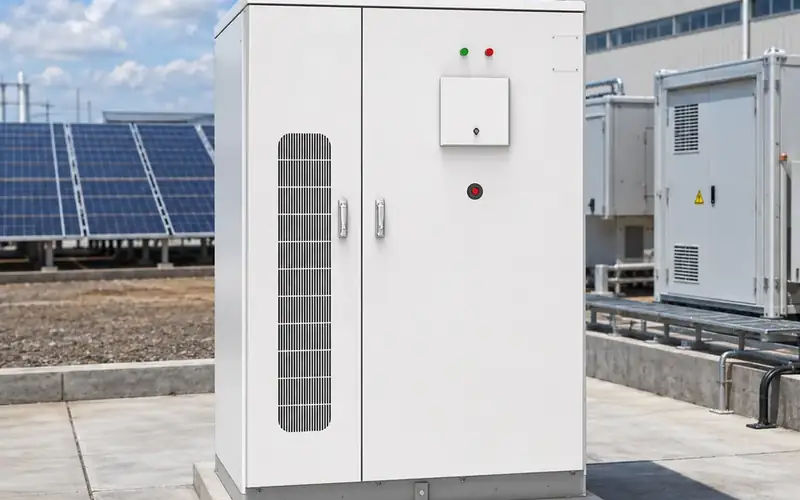
- Outdoor liquid-cooled cabinets cover roughly 100–500 kWh per unit; containers cover the MWh range. Many sites combine several cabinets.
- Decide early between AC-coupled and DC-coupled solar integration, and whether the system must run in backup (island) mode.
- Safety approval depends on the local fire code and insurer. Ask for system-level test reports, not just cell certificates.
- Compare offers on usable energy at the meter, warranted end-of-life capacity and auxiliary consumption, not nameplate kWh alone.
What is a commercial battery storage system?
A commercial battery storage system contains the same building blocks as any battery energy storage system: lithium cells (usually LFP), a battery management system, a bidirectional power conversion system (PCS), thermal management, fire detection and suppression, and an energy management system (EMS). The difference from utility storage lies in where it connects and what it optimises.
Commercial systems sit on the customer side of the utility meter, so their value comes mainly from reducing the customer's electricity bill and protecting operations. Industrial energy storage follows the same principles at a larger scale, often with medium-voltage connection and heavy motor loads. If you are new to the terminology, our explainer on what a battery energy storage system is covers the basics.
What are commercial energy storage systems used for?
Most C&I projects combine two or more of these value streams:
- Demand charge reduction. Discharge during the highest-demand intervals of the billing period. This is often the largest saving for sites on demand tariffs. See our guide to peak shaving with battery storage.
- Energy arbitrage and load shifting. Charge during off-peak periods and discharge during expensive time-of-use periods.
- Commercial solar battery storage. Store PV generation that would otherwise be exported cheaply or curtailed by an export limit, and use it later in the day.
- Backup and power quality. Keep critical loads running during outages or voltage dips, and reduce reliance on standby diesel generators.
- Demand response and grid services. Where programmes exist, earn payments for reducing load or exporting at the grid operator's request.
- Grid-connection relief. Avoid or delay an expensive connection upgrade by covering short peaks from the battery, for example at EV charging hubs.
The EMS has to be programmed for the chosen mix. Reserving capacity for backup, for example, reduces the energy available for daily peak shaving.
Cabinet or container: which format fits a commercial site?
The format is driven mainly by required energy, available space and installation constraints.
| Feature | Outdoor cabinet | Battery storage container |
|---|---|---|
| Typical energy per unit | About 100–500 kWh | About 1–5 MWh per 20 ft unit, depending on cell size and layout |
| Typical sites | Shops, offices, small factories, EV charging, farms | Large factories, logistics hubs, campuses, mines |
| PCS arrangement | Often integrated in the cabinet | Integrated, or in a separate PCS skid or room |
| Expansion | Add cabinets in parallel | Add containers or reserve space for augmentation |
| Installation | Small foundation, light crane or forklift | Larger foundation, heavy crane, wider access |
| Grid connection | Usually low voltage (400/480 V class) | Low voltage or medium voltage via step-up transformer |
The liquid-cooled storage cabinet range, including units such as the 344 kWh C&I cabinet with 280 Ah LFP cells, suits most single-building sites. For larger loads, battery storage containers such as the outdoor 2,000 kWh container in 20 ft or 40 ft cover the MWh scale.
How should commercial solar battery storage be coupled?
There are two common ways to combine a battery with an on-site PV system:
- AC coupling. The battery has its own PCS connected to the site's AC bus, independent of the solar inverters. This is the easiest option for retrofits and lets the battery charge from the grid as well as from solar. Energy from PV to battery passes through two conversions, which adds some loss.
- DC coupling. The battery and PV share a DC bus and a hybrid inverter. This avoids one conversion step and can capture PV energy that would otherwise be clipped by the inverter's AC limit. It suits new-build projects designed together from the start.
Check the export limit, the protection settings agreed with the utility and whether the system must be able to island. Backup operation needs a grid-forming PCS, an automatic transfer arrangement and a review of motor-starting and transformer inrush currents.
What data do you need to size a commercial battery?
Supplier proposals are only as good as the input data. Prepare:
- At least 12 months of interval meter data (15-minute or 30-minute, matching the tariff's demand interval).
- The full tariff structure: energy rates by time period, demand charges, ratchet clauses and any reactive power charges.
- Existing or planned PV capacity, inverter details and export limits.
- A single-line diagram showing the connection point, transformer rating and main switchboard.
- A list of critical loads, if backup is required, with their starting currents.
- Site layout, ambient temperature range, altitude and access constraints.
With this data, the supplier can model the battery's dispatch and size power and energy separately. Our guide on how to size a BESS container walks through the corrections from delivered energy to nameplate kWh, which apply equally to cabinets.
Which safety standards apply to commercial energy storage?
Commercial sites are often close to occupied buildings, so fire safety and siting get close scrutiny. Typical requirements include:
- IEC 62619 for lithium cells and batteries in industrial applications and IEC 62933-5-2 for electrochemical energy storage system safety.
- UL 9540 system listing and UL 9540A thermal runaway test data in North America, with installation to NFPA 855 and the local fire code.
- National rules on separation distances from buildings, property lines and escape routes, and on fire service access.
- In the European Union, Regulation (EU) 2023/1542 on batteries introduces requirements for industrial batteries, including labelling, carbon footprint information and a digital battery passport scheduled to apply from February 2027 for industrial batteries over 2 kWh. The full text is on EUR-Lex.
Your insurer may have its own requirements on gas detection, suppression type and explosion venting. Confirm them before fixing the site layout.
How do you compare commercial battery storage offers?
Nameplate kWh is the easiest number to compare and the least informative. Use a table like this when reviewing proposals:
| Item to compare | Why it matters |
|---|---|
| Usable energy at the AC meter, beginning of life | Accounts for the state-of-charge window and conversion losses |
| Warranted capacity at end of warranty, under your duty cycle | Determines whether savings hold up over the years |
| Round-trip efficiency, with and without auxiliaries | Cooling and controls can add a noticeable continuous load |
| PCS kVA rating at maximum site temperature | Many inverters derate in hot climates |
| Cycle and throughput limits in the warranty | Exceeding them can void the capacity guarantee |
| EMS functions included | Peak shaving, time-of-use, PV self-consumption, backup, remote monitoring |
| System-level test reports | Must match the exact cell, module and enclosure offered |
| Spare parts, remote support and response times | Downtime erodes savings quickly |
Also check logistics. Lithium batteries ship as dangerous goods (UN 3480, class 9), and the state of charge at shipment, packing and documents all affect delivery time. Our guide to shipping transformers and BESS covers Incoterms and packing.
Frequently asked questions
What size battery does a commercial building need?
There is no single answer; it depends on the load profile, tariff and goals. Peak-shaving systems are sized on the kW to be removed and how long the peaks last, while solar storage is sized on the daily surplus. Interval meter data is the starting point for any sizing study.
Is industrial energy storage different from commercial storage?
The technology is the same, but industrial sites usually have larger loads, medium-voltage connections, motor starting and harsher environments. That leads to larger systems, often containers with step-up transformers, and closer attention to power quality and protection coordination.
Can a commercial battery work during a power cut?
Only if it is designed for it. Backup operation needs a PCS that can form its own voltage and frequency, a transfer switch or breaker scheme that isolates the site from the grid, and enough reserved energy. Grid-following systems shut down during an outage by design.
Are liquid-cooled cabinets better than air-cooled for commercial use?
Liquid cooling keeps cell temperatures more uniform and allows higher energy density per cabinet, which helps in hot climates and with frequent cycling. Air cooling is simpler and can suit smaller or lightly cycled systems. Our comparison of liquid cooling vs air cooling explains the trade-offs.
What is the typical lifetime of a commercial battery storage system?
LFP commercial systems are commonly designed for 10 to 20 years, with capacity fading gradually over that period. The warranted lifetime depends on cycles per day, temperature and depth of discharge, so ask for a capacity-retention curve under your intended operation.
Ready to scope a system? Send your interval data, tariff and single-line diagram through our contact page, and our engineering team will prepare a technical proposal with a sized battery, PCS and grid connection.