What is a microgrid and what equipment does it need?
What is a microgrid? A microgrid is a local group of electrical loads and energy sources, such as solar, wind, generators and battery storage, that operates as one controllable system within a clear electrical boundary. It can run connected to the main grid or disconnect and run on its own in island mode. It needs generation, storage, a grid-forming inverter, switchgear and a microgrid controller.
Key takeaways
- A microgrid has three defining features: a clear electrical boundary, its own local energy sources and a controller that manages them as a single system.
- The ability to island, meaning to separate from the grid and keep supplying its loads, is what distinguishes a microgrid from a site that simply has solar panels.
- Battery storage with a grid-forming power conversion system is now the usual voltage and frequency reference in an island, often alongside diesel or gas generators.
- The microgrid controller handles dispatch and the transitions between grid-connected and island operation.
- Protection, earthing and switchgear need specific design attention, because inverter-based sources supply much less fault current than the grid.
What is a microgrid? The formal definition
The US Department of Energy uses a widely quoted microgrid definition: a group of interconnected loads and distributed energy resources within clearly defined electrical boundaries that acts as a single controllable entity with respect to the grid, and that can connect and disconnect from the grid to operate in either grid-connected or island mode.
Each part of that sentence matters:
- Interconnected loads and distributed energy resources. The microgrid contains both consumption and local supply, such as PV, wind, generators, combined heat and power, and batteries.
- Clearly defined electrical boundaries. There is a known point, or several points, of common coupling (PCC) with the wider grid.
- Single controllable entity. From the grid's point of view, the microgrid behaves like one customer or one generator, not a collection of independent devices.
- Connect and disconnect. It can island deliberately or in response to a grid fault, and later reconnect.
Remote systems with no grid connection at all are often also called microgrids (or off-grid microgrids), even though they are permanently islanded.
What types of microgrid are there?
Microgrid solutions are usually grouped by where they sit and what they serve.
| Type | Grid connection | Typical energy sources | Typical purpose |
|---|---|---|---|
| Campus or facility microgrid | Grid-connected, islands during outages | PV, battery, standby generators, sometimes CHP | Resilience for hospitals, universities, data centres, military bases, factories |
| Community or utility microgrid | Grid-connected, part of a distribution feeder | PV, battery, generators | Keep critical community services running during grid events |
| Remote or island microgrid | No grid, or a weak connection | PV, wind, battery, diesel or gas generators | Supply islands, villages, mines and remote camps while cutting fuel use |
| Industrial off-grid microgrid | No grid | Gas or diesel generators, PV, battery | Power mines, oil and gas sites, construction or process plants |
| DC microgrid | Usually grid-connected via converters | PV, battery, DC loads | Data centres, EV charging, telecom, some buildings |
A typical island system is shown in this 13.8 kV containerised substation application example for an island microgrid, which is a representative configuration rather than a delivered project.
How does islanding work in a microgrid?
Islanding means operating part of the network separately from the main grid. There are two cases, and they are treated very differently.
Unintentional islanding is a safety hazard. If a section of a utility feeder stays energised by distributed generation after the utility has disconnected it, line workers and equipment are at risk. Interconnection standards such as IEEE 1547 therefore require ordinary grid-following inverters to detect loss of grid and stop exporting within a short time (two seconds under IEEE 1547). This is anti-islanding protection.
Intentional islanding is the planned, controlled version that microgrids are designed for. A typical sequence is:
- The microgrid controller detects a grid disturbance or receives a command to island.
- The breaker at the point of common coupling opens, separating the microgrid from the utility.
- A grid-forming source, typically a battery inverter or a generator, takes over as the voltage and frequency reference.
- The controller sheds non-critical loads if supply is insufficient and dispatches the remaining sources to balance load.
- When the grid returns and is stable, the controller synchronises the microgrid voltage, frequency and phase angle to the grid and closes the PCC breaker.
Whether the transition is seamless or involves a short outage depends on the PCS, the switching scheme and the protection design. Specify the required transfer behaviour clearly.
What equipment does a microgrid need?
Every microgrid is different, but most include the following.
| Equipment | Role in the microgrid | Design points |
|---|---|---|
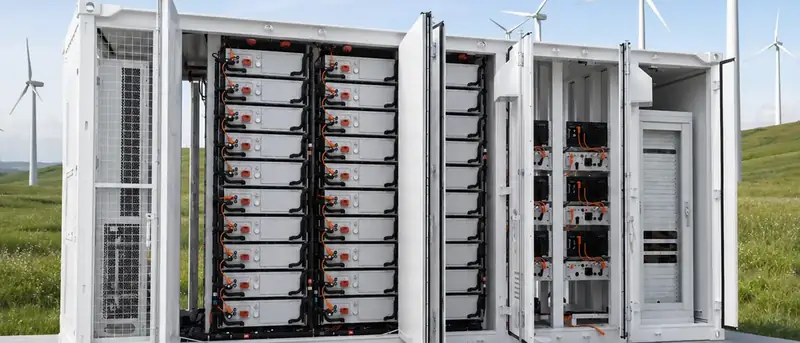
| Battery energy storage system | Balances fast changes in load and renewables; often the grid-forming reference in island mode | Grid-forming PCS, power rating for motor starting, energy for the required autonomy |
| Solar PV and wind | Reduce fuel use and energy cost | Curtailment control, inverter settings for island mode |
| Diesel or gas generators | Firm capacity for long periods of low renewable output | Minimum loading limits, start-up time, fuel logistics |
| Microgrid controller | Dispatches all sources, manages islanding and reconnection | Control functions, communications, cybersecurity |
| PCC breaker and synchronising equipment | Separates and reconnects the microgrid | Synchronism check, protection interlocks |
| MV switchgear and ring main units | Distribute power and isolate faults inside the microgrid | Protection relays with setting groups for grid and island modes |
| Transformers and substations | Step between generator, PCS and distribution voltages | Vector group and earthing arrangement in island mode |
| Metering, SCADA and communications | Provide data for control and billing | Response times, redundancy |
Battery storage is usually the core of modern microgrid solutions. Our explainer on what a battery energy storage system is covers its components. For remote sites, an off-grid high-voltage lithium battery storage system or a diesel-hybrid lithium battery storage cabinet are typical building blocks. Distribution inside the microgrid often uses a container substation for 12/24/36 kV to 400/415 V and ring main units; see our comparison of SF6 vs solid-insulated ring main units.
What does a microgrid controller do?
The microgrid controller is the system-level brain. IEEE 2030.7, the IEEE standard for the specification of microgrid controllers, describes two core functions:
- Dispatch. Deciding the setpoints of each energy source and controllable load, in both grid-connected and island modes, to keep supply and demand balanced and meet economic or operational goals.
- Transition. Managing the move from grid-connected to island mode (planned or unplanned), and back again through resynchronisation.
On top of these, practical controllers handle load shedding priorities, battery state-of-charge management, generator start and stop logic, renewable curtailment, and communication with the utility. The individual device controls, such as the PCS current loop or a generator governor, sit below the microgrid controller.
Why are grid-forming inverters important?
Most solar and battery inverters connected to a strong grid are grid-following: they measure the grid voltage and inject current in step with it. Without a grid to follow, they cannot operate.
A grid-forming inverter creates its own voltage and frequency, as a generator does. In an island microgrid, at least one grid-forming source must set the reference that the other inverters follow. Battery systems are well suited to this role because they can absorb and supply power within milliseconds. In many modern designs, the battery forms the grid during sunny hours so that generators can be switched off, and generators restart only when the battery state of charge falls.
When specifying a BESS for a microgrid, ask whether the PCS is grid-forming, how many units can operate in parallel in grid-forming mode, and how it handles motor starting and transformer inrush currents.
What are the main protection challenges in a microgrid?
Protection is often the hardest part of microgrid design:
- Low fault current. Inverter-based sources typically supply only modestly more than their rated current during a fault, far less than a utility source. Overcurrent relays set for grid-connected faults may not trip in island mode.
- Two operating states. Relays usually need separate setting groups for grid-connected and island operation, switched automatically by the controller.
- Earthing. When the microgrid islands, it must still have a proper neutral reference. The transformer vector group and earthing arrangement at the PCC have to be checked for both states.
- Bidirectional power flow. Feeders may carry power in either direction, which affects directional elements and coordination.
Address these during the single-line diagram stage, not during commissioning.
Frequently asked questions
What is a microgrid in simple terms?
A microgrid is a small, local power system that can run on its own. It combines local energy sources, often solar, batteries and generators, with the buildings or equipment it supplies, and can disconnect from the main grid during an outage and keep working.
Is a house with solar and a battery a microgrid?
Strictly, only if it can island and control its own sources as one system. Many home solar systems shut down during outages by design. A system with a grid-forming battery inverter and an automatic transfer switch behaves like a very small microgrid, sometimes called a nanogrid.
Can a microgrid run without batteries?
Yes. Traditional microgrids used generators as the grid-forming source. Adding batteries allows higher renewable penetration, fewer generator run hours and faster response to load changes, which is why most new microgrid designs include storage.
What is the difference between a microgrid and a virtual power plant?
A microgrid is physically connected within an electrical boundary and can island. A virtual power plant aggregates distributed resources across many locations through software to trade or provide grid services, without any shared local network or islanding capability.
How big is a microgrid?
Microgrids range from tens of kilowatts for a single building or remote telecom site to tens of megawatts for large campuses, mines or islands. The size is set by the load and the required autonomy, not by any fixed definition.
Planning a microgrid? Send your load profile, single-line diagram and resource data through our contact page, and our engineering team will return a technical proposal covering battery storage, PCS, transformers and switchgear.