Ring main units: SF6 vs solid-insulated vs air-insulated
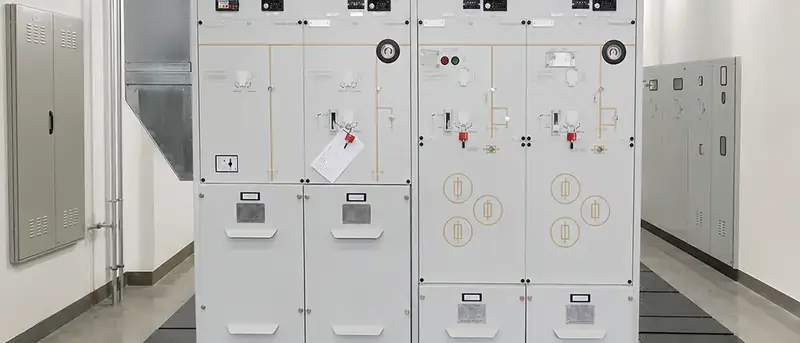
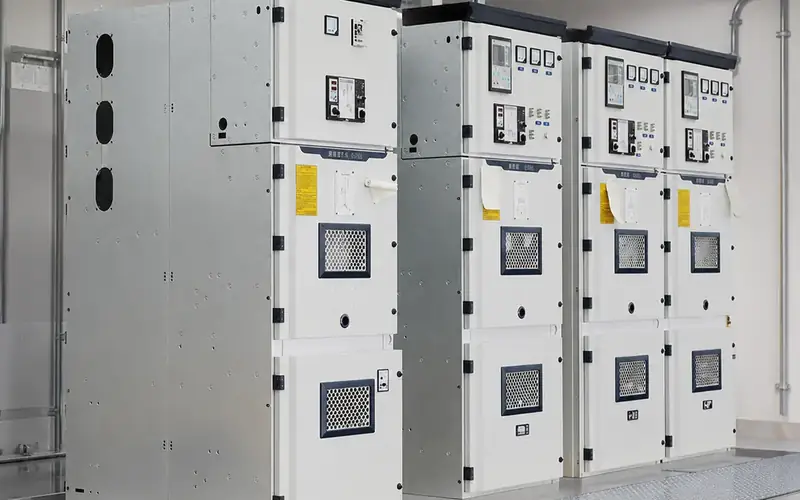
A ring main unit (RMU) is compact, factory-assembled medium-voltage switchgear that connects a distribution transformer or feeder to a cable ring. SF6 units are the most compact and long-established, solid-insulated units encapsulate live parts in epoxy, and air or dry-air units avoid fluorinated gases. In the EU, new switchgear up to 24 kV that relies on F-gases has been restricted since 1 January 2026.
Key takeaways
- RMU configuration codes describe the functional units from left to right: for example CCV is two cable switches and one vacuum circuit breaker, CCF is two cable switches and one switch-fuse.
- SF6 RMUs are compact and sealed for life, but SF6 is a very potent greenhouse gas. Under Regulation (EU) 2024/573, new F-gas switchgear is restricted from 2026 (up to 24 kV) and 2030 (above 24 kV to 52 kV), with limited derogations.
- Solid-insulated and dry-air RMUs with vacuum interrupters are the main SF6-free routes at medium voltage.
- Specify the internal arc classification (IAC) to IEC 62271-200 for the actual room or kiosk layout, not just "arc tested".
- A good RMU specification lists the configuration, ratings, insulation medium, IAC, LSC class, protection and automation needs, and site conditions.
What is a ring main unit, and where is it used?
Urban and industrial MV networks are often built as open rings with one normally open point. If a cable section fails, operators isolate it and close the open point so that every substation is fed from the other direction.
The RMU is the switchgear at each secondary substation. It typically has two "ring" switches for the incoming and outgoing cables and one "tee-off" function that protects the local transformer or a feeder. RMUs are commonly installed in compact substations, building switch rooms, wind turbines and solar inverter stations.
Within the IEC framework, an RMU is AC metal-enclosed switchgear covered by IEC 62271-200, with its switching devices covered by their own parts: IEC 62271-103 for switches, IEC 62271-105 for switch-fuse combinations, IEC 62271-100 for circuit breakers and IEC 62271-102 for disconnectors and earthing switches, all built on the common specifications of IEC 62271-1.
What do RMU configuration codes like CCV and CCF mean?
Most manufacturers name RMUs by listing the functional modules from left to right. The letters are a manufacturer convention rather than an IEC designation, so always check the supplier's legend. A widely used scheme is:
| Code | Functional unit | Typical use |
|---|---|---|
| C | Cable switch: three-position load-break switch (closed / open / earthed) | Ring incoming and outgoing cables |
| F | Switch-fuse combination with HV fuses | Protecting a distribution transformer |
| V | Vacuum circuit breaker with disconnector / earthing switch and protection relay | Larger transformers, feeders, or where relay selectivity and remote tripping are needed |
| D / De | Direct cable connection, without or with earthing switch | Connecting a cable directly to the busbar |
| M | Metering unit with CTs and VTs | Revenue or check metering on the MV side |
| S (with suffix) | Busbar sectionaliser | Splitting the busbar into two sections |
So:
- CCF is a three-way RMU with two ring switches and one fused transformer feeder. It is the classic choice for a single distribution transformer in a secondary substation.
- CCV replaces the fuse with a vacuum circuit breaker and relay, which suits larger transformers or networks where the tee-off must coordinate with upstream protection.
- CCCF, CCVV and similar four- or five-way units add further ring or feeder circuits.
- DeV is a compact two-way unit: a cable with earthing switch plus a breaker, used for example at the end of a radial feeder or in renewable collection systems.
RMUs are offered as non-extensible (a fixed block) or extensible (modules can be coupled later). If the site may grow, specify extensibility at the start.
How do SF6, solid-insulated and air-insulated RMUs differ?
The insulation medium sets the size, the environmental profile and the maintenance approach.
| Feature | SF6 gas-insulated | Solid-insulated (epoxy) | Air- or dry-air insulated |
|---|---|---|---|
| Insulation of live parts | SF6 gas in a sealed stainless steel tank | Epoxy-encapsulated poles and busbars, often with earthed (screened) outer surfaces | Atmospheric air (AIS) or pressurised dry or synthetic air in a sealed tank |
| Interruption | SF6 load-break switch; vacuum or SF6 breaker | Vacuum interrupters | Vacuum interrupters |
| Size | Most compact; mature designs to 24 kV and above | Compact, modular; footprint close to SF6 at 12 kV and 24 kV | AIS is larger; sealed dry-air designs are close to SF6 size |
| Climate and pollution sensitivity | Very low inside the tank | Low, if the surface earthing and cable interfaces are well executed | AIS is sensitive to humidity, dust and condensation; sealed dry-air units are not |
| Maintenance | Sealed for life; gas pressure monitoring; certified handling at end of life | No gas handling; inspect interfaces and mechanisms | AIS needs periodic cleaning and inspection; sealed units are similar to SF6 |
| Environmental profile | SF6 has a GWP of about 24,300 under the F-gas Regulation | No F-gas | No F-gas |
| EU status for new units up to 24 kV | Restricted from 1 January 2026 | Permitted | Permitted |
Note that some alternative gas mixtures based on fluoronitriles or fluoroketones have a much lower GWP than SF6 but are still fluorinated gases. That matters for the EU rules below.
What does the EU F-gas Regulation 2024/573 mean for MV switchgear?
Regulation (EU) 2024/573 replaced the earlier F-gas Regulation in March 2024. Article 13 phases out the putting into operation of new switchgear that relies on fluorinated greenhouse gases for insulation or breaking. The timetable is:
| Equipment | Restriction applies from | Gases affected |
|---|---|---|
| MV switchgear for primary and secondary distribution, up to and including 24 kV | 1 January 2026 | F-gases (SF6 and other F-gas alternatives) |
| MV switchgear for primary and secondary distribution, above 24 kV up to and including 52 kV | 1 January 2030 | F-gases |
| HV switchgear above 52 kV up to 145 kV and up to 50 kA | 1 January 2028 | F-gases with GWP of 1 or more |
| HV switchgear above 145 kV or above 50 kA | 1 January 2032 | F-gases with GWP of 1 or more |
Key points for buyers:
- The restriction is on putting new equipment into operation. Existing SF6 switchgear can stay in service, and parts can be installed for repair and servicing under conditions in the regulation.
- Switchgear ordered under contracts concluded before 11 March 2024 is exempt, with evidence of the order date.
- Derogations exist when a tender receives no suitable F-gas-free offer (or offers from only one manufacturer in the first two years), in which case equipment using F-gases with a GWP below 1,000 may be allowed. The operator generally has to notify the competent national authority and keep evidence.
National authorities and network operators publish their own interpretations, so check local guidance and take legal advice for borderline cases. Outside the EU, many utilities and developers now ask for SF6-free equipment regardless of local law.
What is internal arc classification (IAC) to IEC 62271-200?
An internal arc is a fault inside the enclosure that releases hot gas and pressure very quickly. IEC 62271-200 defines a type test and classification showing which sides of the switchgear protect a person standing there during such a fault. A rating is written like this: IAC AFLR 20 kA 1 s.
- A or B is the accessibility type: A means access restricted to authorised personnel; B means unrestricted access, including the general public. A type C also exists for equipment mounted out of reach.
- F, L, R are the accessible sides tested: front, lateral and rear. Only sides marked are covered.
- 20 kA 1 s is the arc fault test current and duration.
When specifying IAC:
- Match the accessibility type to the location: a locked switch room is usually type A; a pavement kiosk accessible to the public needs the substation enclosure evaluated (IEC 62271-202 covers prefabricated substations).
- Include every side a person can stand next to. Wall-mounted units may only need F and L; free-standing units in a room usually need all sides that are accessible.
- Choose a test current at least equal to the prospective short-circuit current at the installation, and a duration that matches or exceeds the upstream protection clearing time.
- Check how the arc gases are vented (downwards into a cable trench, upwards, or into an absorber) and that the room or kiosk design matches the tested arrangement.
Also specify the loss of service continuity category (LSC, for example LSC2) and partition class, which define what stays live when a compartment is opened.
How should you specify an RMU?
Send your supplier a specification that covers at least:
- Network data: rated voltage, frequency, system earthing (grounding), and prospective short-circuit current and duration.
- Configuration: the functional units in order (for example CCV), and whether the unit must be extensible.
- Ratings: busbar and feeder currents, short-time withstand current, and the transformer rating to be protected.
- Insulation medium: SF6, solid-insulated or dry-air, and any F-gas restriction that applies at the destination.
- Internal arc classification, LSC category, enclosure IP rating and installation (indoor, outdoor, in a compact substation).
- Protection and automation: fuse or relay type, CT ratios, motor operators, fault passage indicators, RTU interface and protocol.
- Cable connection: bushing type, cable size and number of cables per phase.
- Site conditions: altitude, ambient temperature range, humidity, pollution and seismic requirements.
Our transformer RFQ checklist covers many of the same documentation points.
Toppower Asia supplies sealed SF6 ring main units for 12 kV and 24 kV, an intelligent solid-insulated ring network cabinet for 12–33 kV and a compact RMU for 6.3–12 kV networks. For EU projects, confirm the insulation and switching medium in the technical agreement so that the delivered unit is F-gas free. RMUs are also a core part of compact substations; our article on pad-mounted transformers vs compact substations and the Vietnam 22 kV/0.4 kV compact substation application example show how they fit into a complete package.
Frequently asked questions
Can I still buy SF6 ring main units for projects in the EU?
For new MV switchgear up to 24 kV, putting F-gas units into operation has been restricted since 1 January 2026, subject to limited derogations and the pre-11 March 2024 order exemption. Above 24 kV up to 52 kV, the restriction starts on 1 January 2030. Outside the EU, SF6 RMUs remain widely available, subject to local rules.
Is a solid-insulated RMU as reliable as an SF6 RMU?
Solid-insulated designs with vacuum interrupters have a long service record at 12 kV and 24 kV. Reliability depends on the quality of the epoxy casting, partial discharge testing in the factory and correct cable termination on site, so ask for routine test reports including partial discharge measurements.
What is the difference between CCF and CCV?
Both have two ring cable switches. CCF protects the transformer with a switch-fuse combination, which is simple and economical for smaller transformers. CCV uses a vacuum circuit breaker with a protection relay, which suits larger transformers, feeders and networks that need relay coordination or remote tripping.
What IAC rating should a ring main unit have?
It should match the installation: accessibility type A for restricted switch rooms, or a substation-level evaluation for public locations, with all accessible sides (F, L, R) included. The test current should be at least the prospective fault level, commonly 16 kA or 20 kA at distribution voltages, for a duration matching the upstream protection. If you are planning an MV ring network or a secondary substation, send us your single-line diagram and specification and our engineering team will return a technical proposal with the recommended RMU configuration and insulation option.