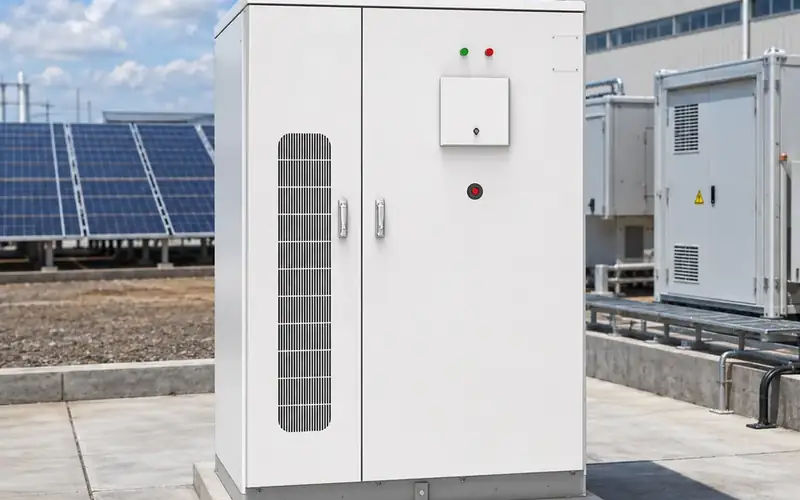
LFP vs NMC: types of lithium-ion batteries for energy storage
The main types of lithium-ion batteries are named after their cathode chemistry: LFP (lithium iron phosphate, LiFePO4), NMC (nickel manganese cobalt), NCA, LMO and LCO, plus LTO, which changes the anode. For stationary energy storage, LFP is now the default because it is more thermally stable, lasts more cycles and avoids cobalt and nickel. NMC remains stronger where weight and volume matter most.
Key takeaways
- "Lithium-ion" is a family, not one battery. The cathode (and sometimes anode) material sets the voltage, energy density, cycle life, safety behaviour and cost.
- LFP cells have a nominal voltage of about 3.2 V and lower energy density than NMC (about 3.6–3.7 V), but they tolerate abuse better and typically deliver several thousand cycles under stationary duty.
- In thermal runaway tests, LFP cells generally reach much lower peak temperatures and release less heat than NMC cells, although LFP off-gas is still flammable.
- For containers and C&I cabinets, the cell chemistry matters less than how it is integrated: BMS, thermal management, fire detection and the warranty terms.
What are the main types of lithium-ion batteries?
Every lithium-ion cell has a cathode, an anode (usually graphite), a separator and a liquid electrolyte. Lithium ions shuttle between the electrodes as the cell charges and discharges. Changing the cathode material is the main way manufacturers trade energy density against life, safety and cost.
| Chemistry | Cathode / anode | Nominal cell voltage | Energy density | Cycle life (typical) | Main applications |
|---|---|---|---|---|---|
| LFP (LiFePO4) | Lithium iron phosphate / graphite | ~3.2 V | Moderate | High | Stationary storage, buses, many EVs, telecom backup |
| NMC | Nickel manganese cobalt oxide / graphite | ~3.6–3.7 V | High | Moderate | EVs, earlier BESS designs, power tools |
| NCA | Nickel cobalt aluminium oxide / graphite | ~3.6 V | High | Moderate | Some EVs, high-energy cylindrical cells |
| LMO | Lithium manganese oxide / graphite | ~3.7 V | Moderate | Lower | Power tools, blended with NMC in some packs |
| LCO | Lithium cobalt oxide / graphite | ~3.6–3.7 V | High | Lower | Phones, laptops, small electronics |
| LTO | NMC or LMO cathode / lithium titanate anode | ~2.3–2.4 V | Low | Very high | Fast-charge, low-temperature and high-power niches |
Values vary between cell designs and manufacturers, so treat this table as a qualitative guide and use the cell datasheet for engineering.
Two other terms cause confusion. "Lithium polymer" describes a pouch format with a gel or polymer-modified electrolyte, not a separate cathode chemistry. Sodium-ion cells are emerging for stationary use, but they are not lithium-ion batteries and are outside the scope of this article.
What is a LiFePO4 battery?
A LiFePO4 battery uses lithium iron phosphate in an olivine crystal structure as its cathode. The strong phosphorus-oxygen bonds make the material much less likely to release oxygen when overheated than layered nickel or cobalt oxides. That is the root of LFP's safety advantage.
Practical consequences for stationary storage:
- Flat voltage curve. An LFP cell sits near 3.2–3.3 V across most of its state of charge (SOC). This is good for the inverter but makes SOC estimation harder, so the battery management system relies on coulomb counting and periodic calibration rather than voltage alone.
- Long cycle life. Large-format prismatic LFP cells for storage are commonly rated for several thousand full cycles, with many datasheets quoting 6,000 or more to 70–80% remaining capacity under defined test conditions.
- No cobalt or nickel. Iron and phosphate are abundant, which has helped bring LFP cell prices below those of NMC.
- Lower energy density. LFP stores less energy per kilogram and per litre, which matters less in a fixed container than in a car.
Typical large storage cells today are prismatic LFP cells of 280 Ah and above, assembled into modules, racks and then complete systems such as our 344 kWh liquid-cooled C&I cabinet with LFP 280 Ah cells.
LFP vs NMC: how do they compare for stationary storage?
The comparison below uses cautious ranges drawn from published cell data. Individual products can sit outside them.
| Criterion | LFP (LiFePO4) | NMC |
|---|---|---|
| Nominal cell voltage | ~3.2 V | ~3.6–3.7 V |
| Gravimetric energy density (cell) | Roughly 140–200 Wh/kg | Roughly 180–280 Wh/kg |
| Cycle life under stationary duty | Several thousand cycles; storage-grade cells often rated 6,000+ | Typically lower, often in the 1,000–3,000 range depending on grade and depth of discharge |
| Thermal runaway behaviour | Lower peak temperature and heat release; cathode releases little oxygen | Higher peak temperature and heat release; nickel-rich grades are more reactive |
| Calendar ageing at high temperature | Moderate | Generally more sensitive, especially at high SOC |
| Low-temperature charging | Restricted near and below 0 °C | Also restricted, slightly better low-temperature performance |
| Critical materials | Lithium, iron, phosphate | Lithium, nickel, cobalt, manganese |
| Cell cost | Generally lower | Generally higher |
| Best fit | Containers, C&I cabinets, daily cycling | Applications where weight and volume dominate |
For a container or cabinet that cycles once or twice a day for 10–15 years, cycle life, safety and cost per kWh outweigh energy density. That is why almost all new utility-scale and commercial systems use LFP, and why our own battery energy storage systems are LiFePO4-based.
Is LFP safer than NMC in a BESS?
LFP is generally safer at cell level, but "safer" does not mean "cannot fail".
In accelerating rate calorimetry studies, the temperature at which self-heating starts can be similar for both chemistries, but what happens next differs sharply. Published tests have recorded NMC cells reaching peak temperatures of several hundred degrees higher than comparable LFP cells, with much greater heat release. Results vary with cell size, format and SOC, so use the supplier's own cell and module test data rather than a generic number.
Three points matter for system design:
- Propagation. The real risk in a BESS is one cell failing and heating its neighbours until a whole module or rack is involved. Spacing, barriers and thermal management decide whether a single-cell event stays contained.
- Off-gas. LFP cells in thermal runaway vent flammable gases, including hydrogen and carbon monoxide. In an enclosed container this can create an explosion hazard, so gas detection, ventilation and deflagration venting or explosion control are still required.
- Standards. Cells and batteries for stationary industrial use are commonly tested to IEC 62619, and many jurisdictions apply NFPA 855 for installation, spacing and fire protection.
Our guide to battery management systems in energy storage explains how monitoring and protection catch faults before they become thermal events.
Which lithium battery types are used in energy storage lithium-ion batteries today?
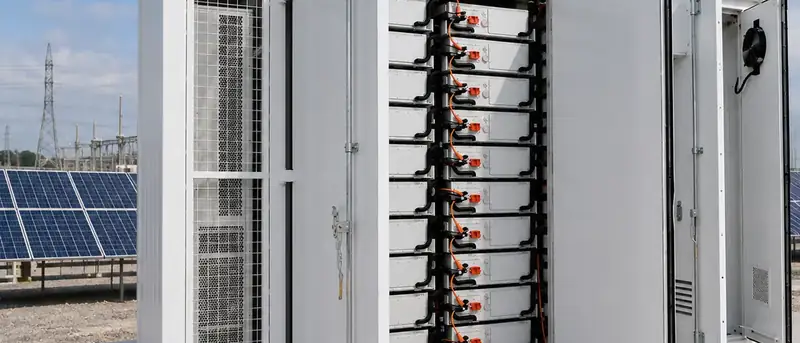
The market has converged on a fairly standard architecture for energy storage lithium-ion batteries:
- Cells: large prismatic LFP cells, commonly 280 Ah to over 300 Ah, with larger formats appearing.
- Modules and packs: cells in series, with module-level voltage and temperature sensing.
- Racks or clusters: modules in series to reach a DC voltage typically in the high hundreds of volts to around 1,500 V DC, managed by a rack-level BMS.
- Thermal management: liquid cooling is now standard in most multi-MWh containers and larger cabinets. See liquid cooling vs air cooling for BESS.
- System: containers of a few MWh or C&I cabinets of tens to a few hundred kWh, paired with a PCS and often a step-up transformer.
NMC still appears in mobile and space-constrained applications, in some residential products and in older installed systems. If you are evaluating a second-hand or legacy NMC system, check its remaining warranty, fire protection design and spare-parts availability carefully.
How should you compare lithium battery storage offers?
Chemistry is the starting point, not the decision. When you compare lithium battery storage proposals, ask for:
- The cell chemistry, format and rated capacity, with the cell datasheet.
- The cycle-life curve: cycles to end of life at a stated temperature, C-rate, depth of discharge and end-of-life capacity (for example 70% or 80%).
- The usable energy at the point of connection, not only the nameplate DC energy.
- Test reports for cells, modules and the system against the standards required at your site.
- Thermal management design and the operating temperature range (see our article on lithium battery temperature range).
- Fire detection, gas detection, suppression and explosion control arrangements.
- Warranty terms: years, throughput or cycles, capacity retention and exclusions.
Our article on how to size a BESS container covers the energy, power and degradation calculations that sit behind these questions. For a worked layout, see the Germany 2 MWh liquid-cooled BESS application example.
Frequently asked questions
What are the different types of lithium-ion batteries?
The main types are LFP (lithium iron phosphate), NMC (nickel manganese cobalt), NCA (nickel cobalt aluminium), LMO (lithium manganese oxide), LCO (lithium cobalt oxide) and LTO (lithium titanate anode). They differ mainly in voltage, energy density, cycle life, thermal stability and cost.
Is a LiFePO4 battery the same as a lithium-ion battery?
Yes. A LiFePO4 (LFP) battery is one type of lithium-ion battery that uses lithium iron phosphate as the cathode. It is sometimes marketed separately because its safety and cycle-life profile differ from cobalt-based chemistries, but it works on the same lithium-ion principle.
Why do most battery storage containers use LFP instead of NMC?
LFP offers longer cycle life, better thermal stability and lower cost per kWh, and it avoids cobalt and nickel. In a fixed installation the lower energy density is a small penalty, because floor space is less constrained than in a vehicle.
How many cycles does an LFP battery last?
Storage-grade LFP cells are commonly rated for several thousand cycles, often 6,000 or more, to a stated end-of-life capacity under controlled conditions. Real life depends on temperature, C-rate, depth of discharge and SOC window, so ask for a capacity-retention curve for your duty cycle.
Can LFP batteries catch fire?
Yes, although less readily and less violently than NMC. LFP cells can enter thermal runaway after overcharge, internal short circuit or external heating, and they release flammable gases. A safe system needs a BMS, thermal management, gas and fire detection and an enclosure designed for explosion control.
If you are comparing battery chemistries or storage offers for a project, send us your load profile, site conditions and single-line diagram and our engineering team will prepare a technical proposal for a LiFePO4 system sized to your application.