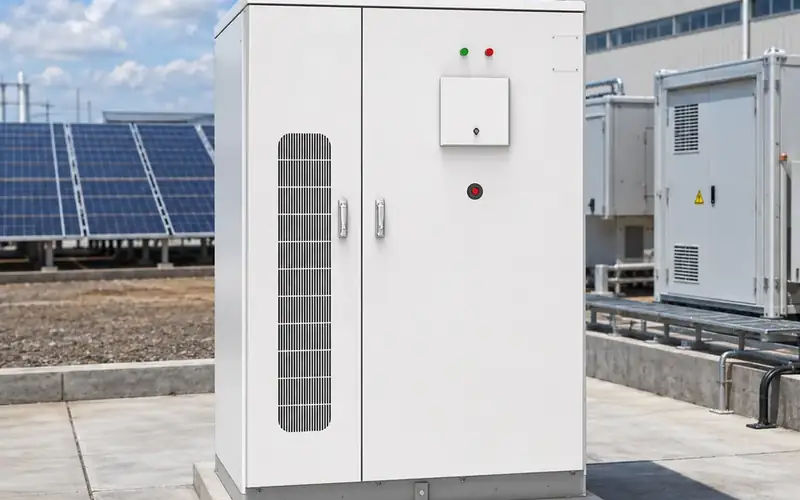
Battery management systems (BMS) in energy storage

A battery management system (BMS) is the electronic control layer that keeps every lithium cell in an energy storage system inside its safe voltage, current and temperature limits. It measures each cell, estimates state of charge and state of health, balances cells, opens contactors when limits are exceeded and reports data to the power conversion system and the energy management system.
Key takeaways
- The BMS is the first line of protection in a lithium BESS. It decides when the battery may charge or discharge, and at what current.
- Large systems use a layered BMS: module-level monitoring, rack (cluster) control and a system-level master.
- State-of-charge estimation is harder for LFP cells than for other lithium chemistries because their voltage curve is flat, so calibration routines matter.
- Balancing, insulation monitoring, contactor control and graded alarms are core functions to check in any specification.
- The BMS works alongside, not instead of, the PCS controls, the EMS and the fire safety system.
What does a battery management system do?
A battery management system for lithium-ion cells has four jobs: measure, estimate, protect and communicate.
- Measure. Cell voltages, module temperatures, rack current, rack voltage and insulation resistance of the DC system.
- Estimate. State of charge (SOC), state of health (SOH) and the allowable charge and discharge power at any moment.
- Protect. Request current reduction when cells approach limits, and open contactors or trip breakers if limits are breached.
- Communicate. Send limits, measurements and alarms to the power conversion system (PCS) and the energy management system (EMS), and log events for later analysis.
Without these functions, a single weak or overheated cell could be overcharged or over-discharged, which accelerates degradation and, in the worst case, can start thermal runaway.
How is a BMS structured in a large BESS?
Containerised and cabinet systems typically use a three-level architecture. Names vary between suppliers, but the functions are consistent.
| Level | Common names | Typical location | Main functions |
|---|---|---|---|
| Module level | Battery monitoring unit, slave board, cell supervision circuit | Inside or on each battery module | Measures every cell voltage and several temperature points; performs passive balancing |
| Rack (cluster) level | Battery cluster management unit, rack controller, high-voltage box | Top or bottom of each rack | Measures rack current and voltage; controls rack contactors, pre-charge and fuses; calculates rack SOC; monitors insulation |
| System level | Battery array management system, master BMS | Control cabinet of the container or cabinet | Aggregates all racks; reports system limits to the PCS and EMS; coordinates rack connection and alarms |
The rack-level unit is usually built into a high-voltage control box with the main positive and negative contactors, a pre-charge circuit, a fuse and a current sensor. In a cabinet like the 372 kWh LFP liquid-cooled storage system, the three levels may sit in one enclosure. In a multi-MWh container, there may be a dozen racks or more reporting to one master.
Why does a lithium battery BMS need such tight limits?
Lithium cells have a narrow safe operating window. For lithium iron phosphate (LFP), the nominal cell voltage is about 3.2 V, and the full operating range is typically about 2.5 V to 3.65 V. The exact limits come from the cell datasheet. Charging above the upper limit or discharging below the lower limit damages the electrodes, and repeated or severe excursions raise the risk of internal short circuits.
Temperature limits are just as important. Charging lithium cells below freezing can cause lithium plating on the anode, which permanently reduces capacity and can create internal shorts. At high temperatures, degradation accelerates and the margin to thermal runaway shrinks. The BMS therefore reduces the allowed charge current at low temperatures and derates power at high temperatures, working together with the thermal management system. Our comparison of liquid cooling vs air cooling explains how cooling design keeps cell temperatures uniform, which makes the BMS's job easier.
How does the BMS estimate state of charge?
State of charge cannot be measured directly. The BMS combines several methods:
- Coulomb counting. It integrates measured current over time to track charge in and out. This is accurate over short periods but drifts because of sensor offset and small errors.
- Open-circuit voltage (OCV) correction. After the battery has rested, cell voltage relates to SOC. The BMS uses this to reset the coulomb counter.
- Model-based filtering. More advanced systems use an equivalent-circuit model and a filtering algorithm to blend current and voltage data in real time.
LFP makes step 2 difficult. Its voltage curve is very flat across most of the SOC range, so a few millivolts can correspond to a large SOC difference. Reliable correction points exist mainly near full and near empty. In daily operation, that means the EMS should periodically allow a full charge (or a controlled calibration cycle) so the BMS can recalibrate. If a supplier quotes SOC accuracy, ask under what conditions and how often calibration is needed.
Passive vs active balancing: which is better?
Cells in a long series string never age identically. Small differences in capacity, self-discharge and temperature cause their SOC to drift apart over time. The weakest cell then limits the whole string, because the BMS must stop charging when the highest cell reaches its upper limit and stop discharging when the lowest cell reaches its lower limit.
| Feature | Passive balancing | Active balancing |
|---|---|---|
| Method | Bleeds energy from higher cells through resistors as heat | Transfers energy from higher cells to lower cells through converters |
| Balancing current | Low (typically tens to a few hundred mA) | Higher, depending on design |
| Cost and complexity | Low | Higher |
| Heat generated | Some, inside the module | Less, as energy is moved rather than dissipated |
| Best suited to | Well-matched cells, regular full charges | Large strings, long life, applications rarely reaching full charge |
Most stationary LFP systems use passive balancing because cells are graded and matched during production. Active balancing can recover more usable capacity in ageing systems, but it adds components that must also be reliable. What matters more than the method is whether balancing capacity is adequate for the duty cycle.
What protection functions should a BESS BMS include?
A complete battery control system should include, at minimum:
- Cell over-voltage and under-voltage protection.
- Over-temperature and under-temperature protection, with charge derating at low temperature.
- Over-current protection in charge and discharge, coordinated with fuses and breakers.
- Insulation monitoring of the floating DC system, with alarm and trip levels.
- Contactor control with pre-charge, welded-contactor detection and safe sequencing.
- Cell voltage and temperature spread alarms, which often give the first sign of a failing cell.
- Loss-of-communication handling, so that the PCS stops if it no longer receives valid BMS limits.
Most BMS designs grade alarms into levels, for example a warning that asks for power reduction, an alarm that stops operation, and a fault that opens contactors and requires investigation. Check that these thresholds are documented and that the PCS responds to each level correctly.
How does the BMS communicate with the PCS and EMS?
The BMS reports allowed charge and discharge current or power, SOC, SOH, alarms and status to the PCS and EMS. Typical interfaces are CAN bus within the battery system and between BMS and PCS, and Modbus over RS485 or Ethernet (Modbus TCP) to the EMS and site SCADA. Some cabinets, such as this DC 1000 V LiFePO4 commercial storage cabinet, expose CAN, RS485 and Ethernet ports for integration.
Interoperability between a BMS and a third-party PCS is one of the most common commissioning delays. If the battery and PCS come from different sources, request the communication protocol document early and confirm it has been tested with the chosen PCS. An integrated product such as this LiFePO4 storage system with integrated BMS and PCS removes that interface risk because the parts are matched before delivery.
What should you ask a supplier about the BMS?
Include these points in your request for quotation:
- Architecture (number of levels) and the number of cell voltage and temperature sensing points per module.
- Voltage and temperature measurement accuracy.
- Balancing method and balancing current.
- SOC and SOH estimation method, stated accuracy and calibration requirements.
- Protection thresholds, alarm levels and response times.
- Communication interfaces, protocol documentation and the list of PCS models already integrated.
- Data logging depth and remote access for warranty analysis.
- Standards and test reports covering the battery system, such as IEC 62619 or UL 1973, and system-level reports such as UL 9540.
For an overview of how the BMS fits into the complete system, read our explainer on what a battery energy storage system is.
Frequently asked questions
What is a BMS in a battery?
A BMS (battery management system) is the electronics and software that monitor and protect a rechargeable battery. It measures cell voltages, temperatures and current, estimates state of charge and prevents operation outside safe limits.
Does a LiFePO4 battery need a BMS?
Yes. Every lithium battery, including LiFePO4, needs a BMS. Although LFP is more thermally stable than other lithium chemistries, overcharging, over-discharging or charging below freezing will still damage cells and can create safety hazards.
What is the difference between a BMS and an EMS?
The BMS protects and reports on the battery itself. The EMS decides how the whole system operates, for example when to charge or discharge for peak shaving, based on tariffs, load and grid signals. The EMS must always respect the limits that the BMS sends.
Can a BMS prevent thermal runaway?
A BMS reduces the likelihood of thermal runaway by keeping cells within limits and detecting early warning signs such as abnormal voltage or temperature spread. It cannot stop an internal cell defect from developing, so gas detection, suppression, venting and cell spacing remain essential.
Why does the SOC on my LFP battery jump after a full charge?
LFP's flat voltage curve makes state-of-charge estimation drift between calibration points. When the battery reaches full charge, the BMS recalibrates against a known reference, so the displayed SOC may correct itself abruptly. Regular full charges keep the estimate accurate.
To compare BMS designs for your project, send us your duty cycle and single-line diagram through our contact page. We will return a technical proposal with a matched battery, BMS, PCS and cooling configuration.