Shipping transformers and BESS from China: Incoterms and packing

To ship transformers, substations or battery containers from China, you agree an Incoterms 2020 rule that fixes who pays for each leg and where risk passes. You then choose packing to suit the equipment: oil-filled or gas-filled tanks, wooden cases or steel frames. Lithium battery systems travel as Class 9 dangerous goods under the IMDG Code. The shipment also needs a complete document set, and the goods must be inspected on arrival.
Key takeaways
- Under FOB and CIF, risk passes to the buyer once the goods are loaded on board the vessel in China. Under DAP, it passes at the named destination. Insure to match the rule you chose.
- Distribution transformers normally ship filled with oil. Large power transformers ship without oil, under dry air or nitrogen at positive pressure, with an impact recorder fitted.
- BESS containers ship as UN 3536 (lithium batteries installed in a cargo transport unit), Class 9. Since 1 January 2026, IMDG Code Amendment 42-24 has required them to be stowed on deck.
- Inspect on arrival, before unloading if possible. Read the impact recorder, check the gas pressure and record any damage on the delivery receipt.
Which Incoterms rule should you use, and who carries the risk?
The Incoterms 2020 rules published by ICC define the delivery point. That is where risk passes from seller to buyer, and where the split of costs changes. The rules most used for power equipment are:
| Rule | Seller pays for | Risk passes to buyer | Insurance | Suits |
|---|---|---|---|---|
| EXW (Ex Works) | Packing only | At seller's premises, before export loading | Buyer | Buyers with their own forwarder in China; export clearance can be awkward |
| FCA (Free Carrier) | Export clearance, delivery to carrier | When handed to buyer's carrier | Buyer | Containerised cargo |
| FOB (Free On Board) | Export clearance, port charges, loading | When on board the vessel at port of shipment | Buyer | Breakbulk and flat-rack cargo |
| CFR (Cost and Freight) | As FOB + ocean freight | On board at port of shipment | Buyer | Buyer arranges own insurance |
| CIF (Cost, Insurance and Freight) | As CFR + insurance | On board at port of shipment | Seller, minimum cover (Institute Cargo Clauses C) | Sea freight, port-to-port |
| CIP (Carriage and Insurance Paid To) | Carriage + insurance to named place | When handed to first carrier | Seller, all-risks cover (Institute Cargo Clauses A) | Containers, multimodal |
| DAP (Delivered At Place) | All transport to named place | At destination, ready for unloading | Seller (in practice) | Buyer handles import clearance and duties |
| DDP (Delivered Duty Paid) | Everything, including import duties | At destination, ready for unloading | Seller | Rare for heavy electrical plant |
Two points cause most disputes:
- CIF and CFR do not move risk to the destination. The seller pays the freight, but if the transformer is damaged at sea the buyer claims on the insurance. CIF only requires minimum cover. For a power transformer, ask for all-risks cover (ICC A) at 110% of the invoice value.
- FOB and CIF are sea-only rules designed for cargo loaded over the ship's rail. For containers, ICC recommends FCA or CIP, because a container is handed to the carrier at the terminal, days before it is loaded on the vessel.
Name the place precisely, for example "FOB Shanghai Yangshan" or "DAP project site, Mombasa Road, Nairobi". The rule decides who is responsible for unloading and import clearance. Under DAP, the buyer still unloads. Under DPU, the seller unloads.
How should a transformer be packed for export?
The packing depends on size, cooling medium and route.
Distribution transformers
Oil-immersed distribution units, up to a few MVA, normally ship fully filled with oil. Hermetically sealed tanks are well suited to this because no oil can surge into a conservator. Each unit is bolted to a timber skid or steel base. Radiators and bushings are protected with timber guards, and the whole unit is either crated in a fumigated or heat-treated wooden case (ISPM 15 marked) or shipped in a closed container with lashing.
Large power transformers
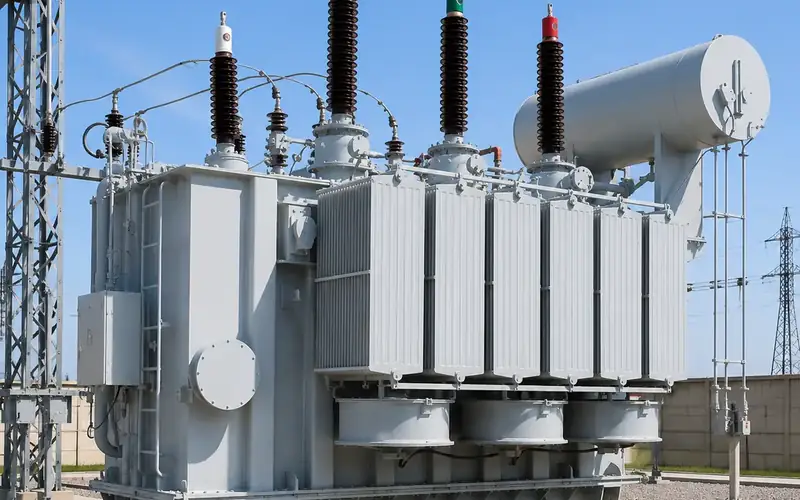
Power transformers are often too heavy to ship with oil. The main tank travels empty, filled with dry air or nitrogen at a small positive pressure, with a gauge and a top-up cylinder so the pressure can be checked during transit. Bushings, radiators, the conservator, fans and the oil are shipped separately in cases and drums. A three-axis impact recorder is fixed to the tank to log shocks during road, rail and sea legs. The recorder data, the gas pressure log and a post-arrival SFRA trace compared with the factory trace are your evidence if the active part has moved. See our power transformer range for typical transport configurations.
Dry-type transformers and switchgear
Cast-resin transformers and switchgear panels are sensitive to moisture and condensation. Pack them in sealed barrier foil with desiccant inside a wooden case, and mark the case "keep dry" and "this way up". The cast-resin dry-type coils must not be lifted by their windings.
Packaged substations
Container and box-type substations usually ship as one assembled unit on their own base frame. The transformer is restrained inside, the switchgear withdrawable parts are locked or removed, and the doors are sealed. Check the overall dimensions early: many substation enclosures are too wide or too tall for an ISO container.
Container, flat-rack or breakbulk?
| Method | When it fits | Watch-outs |
|---|---|---|
| 20 ft / 40 ft dry container | Distribution transformers, switchgear panels, cabinets, accessories | Door opening and floor load; lashing points |
| Open-top container | Units loaded by crane from above, slightly too tall for a dry box | Tarpaulin sealing; rain exposure |
| Flat-rack container | Oversized substations, medium power transformers | Out-of-gauge surcharge; limited slots per vessel |
| Breakbulk (conventional vessel) | Large power transformers, heavy lifts | Port crane capacity at both ends; FOB or CFR terms more natural |
| BESS in its own ISO-type container | 10, 20 or 40 ft battery containers | Must carry CSC plate if shipped as a container; DG rules below |
How are lithium battery containers shipped as dangerous goods?
Lithium-ion batteries, including LiFePO4, are Class 9 miscellaneous dangerous goods. The UN number depends on how they are presented:
- UN 3480: lithium-ion batteries shipped on their own, for example spare modules.
- UN 3481: lithium-ion batteries contained in equipment or packed with equipment, for example a cabinet shipped with its modules installed.
- UN 3536: lithium batteries installed in a cargo transport unit. This is the normal entry for a containerised BESS, where the battery racks are fixed inside the container.
For sea transport the IMDG Code applies. Under UN 3536, special provision 389 requires the batteries to be secured to the container's internal structure and protected against short circuit and damage. Each cell and battery type must have passed the UN Manual of Tests and Criteria, sub-section 38.3 (UN38.3). Amendment 42-24, mandatory since 1 January 2026, made several changes. UN 3536 is now in stowage category D (on deck only), must be protected from heat sources and kept clear of living quarters, and may not be carried on passenger ships above a set size. Manufacturers and distributors must also make the UN38.3 test summary available along the supply chain.
The IMDG Code does not set one state-of-charge figure for UN 3536. Carriers, insurers and P&I clubs ask for a reduced state of charge because it lowers the energy available in a thermal runaway. Agree the figure with the shipping line when you book. For comparison, air transport of standalone lithium-ion batteries (UN 3480) is limited to 30% state of charge under the IATA rules. Lines also commonly ask for the BMS to be powered down, the DC isolators open, and for any fire suppression system to be left in its transport mode.
For sizing and configuration questions, see how to size a BESS container and our battery energy storage systems. The Australia 5 MWh BESS application example shows a representative containerised configuration.
Which documents should travel with the shipment?
- Commercial invoice, with HS codes, Incoterms rule and named place, and values that match the letter of credit if one is used.
- Packing list, giving each case or unit with gross and net weight, dimensions and marks. For out-of-gauge cargo, attach a lifting and lashing drawing.
- Bill of lading: original, telex release or sea waybill as agreed in the payment terms.
- Certificate of origin: a general certificate, or a preferential one where a free-trade agreement applies, so the importer can claim a reduced duty.
- Routine test reports for each serial number, and type test certificates if the contract requires them. See routine tests before shipment.
- Insurance certificate under CIF or CIP.
- For lithium batteries: dangerous goods declaration, safety data sheet (SDS/MSDS), UN38.3 test summary, container packing certificate and the carrier's DG acceptance.
- Country-specific certificates, such as a pre-shipment inspection certificate or conformity certificate where the importing country requires one.
What should you check when the equipment arrives on site?
- Before unloading, read the impact recorder and photograph the display. If a threshold agreed in the contract has been exceeded, notify the supplier and the insurer before the unit is moved further.
- Check the dry air or nitrogen pressure on gas-filled tanks. If it is zero, moisture may have entered the tank, and the insulation should be tested before oil filling.
- Look for oil leaks, dents in the radiators and tank, cracked bushings and damaged cases. Write any damage on the delivery receipt. A clean receipt makes claims much harder.
- Count the cases and check them against the packing list.
- Store dry-type units and switchgear indoors or under cover. Keep BESS containers within the storage temperature range and follow the supplier's instructions on state of charge if they will be stored for a long time.
- Before energisation, repeat insulation resistance, ratio and winding resistance tests, and an oil breakdown test, and compare the results with the factory report.
Frequently asked questions
Is FOB or CIF better for a transformer purchase?
Neither moves risk beyond the port of loading. FOB lets you choose the carrier and insurer, which suits experienced importers. CIF is simpler, but upgrade the insurance to all-risks cover.
Can a BESS container be shipped fully charged?
It is not recommended, and many lines will not accept it. The IMDG Code does not set a single figure for UN 3536, but carriers usually ask for a reduced state of charge. Agree the figure in writing at booking.
Why is my BESS container restricted to on-deck stowage?
Amendment 42-24 to the IMDG Code moved UN 3536 to stowage category D, mandatory from 1 January 2026. On-deck stowage makes it easier to reach and cool the container if a fire starts.
Do oil-filled distribution transformers need dangerous goods declarations?
Mineral transformer oil is generally not classified as dangerous goods for sea transport. Confirm this with the SDS for the specific oil and with your forwarder, because some carriers have their own requirements.
Who pays for unloading under DAP?
The buyer. Under DAP, the seller delivers the goods on the arriving vehicle, ready for unloading. If you want the seller to unload, use DPU and say so explicitly in the contract.
Tell us your destination, preferred Incoterms rule and site access constraints along with your single-line diagram or equipment list, and we will include packing, shipping and document scope in the technical proposal. Contact the Toppower Asia engineering team.