What is electrical switchgear? Types, components and ratings
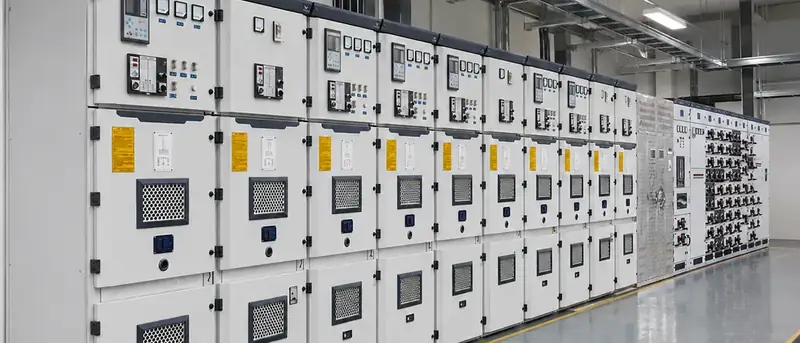
Electrical switchgear is the combination of switching devices, protection, measurement and busbars, housed in an enclosure, that connects, disconnects and protects the circuits of a power system. It lets operators switch loads on and off, isolates equipment safely for maintenance and, through circuit breakers and relays, clears faults automatically before they damage cables, transformers or people.
Key takeaways
- Switchgear does three jobs: switching circuits under normal conditions, protecting them under fault conditions, and isolating them safely for work.
- The main types are grouped by voltage (low, medium, high), by insulation (air, gas, solid) and by construction (fixed or withdrawable).
- Core components are circuit breakers or switches, disconnectors and earthing switches, current and voltage transformers, protection relays, busbars and the enclosure.
- The key ratings are rated voltage and insulation level, rated current, short-time withstand current and duration, internal arc classification and IP rating.
What is switchgear? A practical switchgear definition
IEC uses the formal term "switchgear and controlgear": switching devices and their combination with associated control, measuring, protective and regulating equipment, together with the interconnections, accessories, enclosures and supporting structures. In everyday engineering, "switchgear" means a line-up of factory-built panels (also called cubicles, cabinets or bays) that distribute power from an incoming supply to a number of outgoing circuits.
At medium voltage, metal-enclosed switchgear from above 1 kV up to and including 52 kV is covered by IEC 62271-200. At low voltage, assemblies up to 1,000 V AC fall under IEC 61439. In North America, the equivalent references are the IEEE C37.20 series for switchgear and the UL standards for low-voltage assemblies.
What does switchgear do?
Switchgear sits between sources of power and the loads they feed. It has three functions:
- Switching. Opening and closing circuits under normal load, for example to transfer between supplies, shed load or bring a transformer into service.
- Protection. Detecting abnormal conditions (short circuits, overloads, earth faults) and interrupting the current quickly. A circuit breaker can interrupt the full short-circuit current; a relay decides when to trip it.
- Isolation and earthing. Creating a visible or reliably indicated gap, then earthing (grounding) the circuit, so that people can work on downstream equipment safely.
It also provides metering, monitoring and, increasingly, remote control and communication with a SCADA or energy management system.
What are the main types of switchgear?
Engineers classify switchgear in several overlapping ways.
| Classification | Main types | Typical examples |
|---|---|---|
| By voltage | Low voltage (up to 1 kV AC); medium voltage (above 1 kV to about 52 kV); high voltage (above 52 kV) | 400 V main distribution boards; 12 kV, 24 kV and 36 kV panels; 132 kV substations |
| By insulation medium | Air-insulated (AIS); gas-insulated (GIS, SF6 or alternative gases); solid-insulated (SIS); hybrid | Air-insulated metal-clad panels; sealed SF6 ring main units; epoxy-insulated RMUs |
| By construction | Fixed-type; withdrawable (draw-out) | XGN fixed cabinets; KYN28 withdrawable panels; GCS and MNS drawer-type LV boards |
| By installation | Indoor; outdoor; kiosk or prefabricated substation | Switch rooms; outdoor kiosks; switchgear inside box-type substations |
| By function | Incomer, feeder, bus coupler, metering, transformer feeder, motor control | Main switchboard line-ups; motor control centres |
In Chinese type designations, letters describe the construction. KYN means armoured (metal-clad), withdrawable, indoor; XGN means box-type fixed; HXGN is a ring-network fixed cabinet; GCS and MNS are withdrawable low-voltage designs. You will see these names on many export quotations, alongside IEC ratings.
For a detailed look at MV families, see our medium voltage switchgear guide. The insulation choice, gas-insulated or air-insulated, is covered in the same guide.
What are the main switchgear components?
A typical medium-voltage feeder panel contains the following components. Low-voltage panels have equivalents, usually with air circuit breakers or moulded-case circuit breakers in place of vacuum breakers.
| Component | What it does |
|---|---|
| Circuit breaker | Makes, carries and breaks normal and short-circuit currents. At MV, usually a vacuum circuit breaker; at LV, an air circuit breaker (ACB) or moulded-case circuit breaker (MCCB) |
| Load-break switch | Switches load current but cannot interrupt fault current; often combined with fuses |
| Fuses | Interrupt fault current once, then must be replaced; common for transformer protection in ring main units |
| Disconnector (isolator) | Provides a safe isolating gap; operated off load |
| Earthing switch | Connects the isolated circuit to earth so that work can proceed safely |
| Current transformers (CTs) | Step down current for relays and meters |
| Voltage transformers (VTs) | Step down voltage for relays and meters |
| Protection relay | Measures current and voltage and trips the breaker under fault conditions (overcurrent, earth fault, differential and so on) |
| Busbars | Copper or aluminium conductors that distribute power between panels |
| Surge arresters | Limit overvoltages from lightning or switching |
| Interlocks | Mechanical and electrical logic that prevents unsafe sequences, such as closing an earthing switch onto a live circuit |
| Enclosure and partitions | Protect people and equipment and separate compartments (busbar, breaker, cable, low-voltage) |
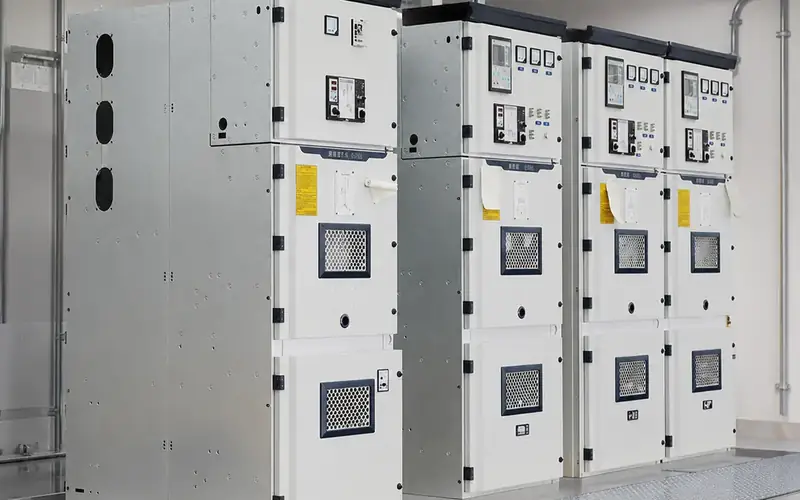
In withdrawable designs such as KYN28A-12 armoured draw-out switchgear, the circuit breaker sits on a truck that can be racked out to a test or disconnected position. Automatic shutters cover the fixed contacts when the truck is withdrawn. This makes maintenance faster and safer than in fixed designs.
Which switchgear ratings should you check?
The rating plate is the contract. These are the ratings to check for MV switchgear under IEC 62271:
- Rated voltage (Ur): the maximum system voltage, for example 12 kV for an 11 kV or 10 kV network, 24 kV for 20 kV or 22 kV, 36 kV for 33 kV. Chinese practice also uses 40.5 kV for 35 kV networks.
- Rated insulation level: the power-frequency withstand voltage and lightning impulse withstand voltage. Common IEC values are 28 kV / 75 kV at 12 kV, 50 kV / 125 kV at 24 kV and 70 kV / 170 kV at 36 kV (some national standards specify higher values).
- Rated normal current (Ir): for busbars and each feeder, for example 630 A, 1,250 A, 2,500 A or 4,000 A.
- Rated short-time withstand current (Ik) and duration (tk): for example 25 kA for 3 s, or 31.5 kA for 1 s or 3 s. This must be at least the prospective fault current at your installation.
- Rated peak withstand current (Ip): normally 2.5 times Ik at 50 Hz, or 2.6 times at 60 Hz.
- Internal arc classification (IAC): for example IAC AFLR 25 kA 1 s, showing which sides protect personnel during an internal arc. See our article on arc flash and internal arc classification.
- Loss of service continuity (LSC) category and partition class: what remains in service when a compartment is opened.
- Degree of protection (IP code): for dust and water ingress, important for outdoor or dusty sites.
For low-voltage assemblies to IEC 61439, the equivalent items are rated operational voltage, rated current of the assembly and of each circuit, rated short-time withstand current (Icw), form of internal separation (Form 1 to Form 4) and IP rating.
How do you choose the right switchgear?
A short, sequential approach avoids most specification gaps:
- Confirm the network data: voltage, frequency, system earthing and prospective short-circuit current.
- Draw or obtain the single-line diagram showing incomers, feeders, bus sections and metering.
- Decide insulation and construction: air-insulated withdrawable panels for main substations, compact gas- or solid-insulated units where space is short.
- Define protection and control: relay functions, CT ratios, interlocking and communication protocol.
- Specify the installation: indoor or outdoor, altitude, ambient temperature, humidity, pollution and seismic requirements.
- List the required tests: type test reports for the design and routine tests on each panel before shipment.
Toppower Asia supplies MV panels such as KYN28 metal-clad switchgear and ring main units, and LV boards such as GCS drawer-type switchgear. You can browse the full range on our HV and LV switchgear page, and the UAE 11 kV commercial switchgear application example shows a representative line-up for a building.
Frequently asked questions
What is the difference between switchgear and a circuit breaker?
A circuit breaker is one device that interrupts current. Switchgear is the complete assembly: breakers, disconnectors, earthing switches, instrument transformers, relays, busbars and the enclosure. A single switchgear line-up usually contains many breakers.
What are the types of switchgear by voltage?
Low-voltage switchgear is used up to 1 kV AC, medium-voltage switchgear from above 1 kV to about 52 kV, and high-voltage switchgear above that. Boundaries differ slightly between standards and countries, so check the definitions used in your project specification.
What is the difference between switchgear and a switchboard?
At low voltage in North America they are distinct product types built to different standards, with switchgear having higher withstand ratings and compartmentalised, usually draw-out breakers. Elsewhere the terms are often used loosely. Our article on switchgear vs switchboard vs panelboard explains the details.
How long does electrical switchgear last?
Well-maintained switchgear is commonly designed for a service life of several decades. Actual life depends on operating environment, switching frequency, fault history and maintenance of mechanisms, contacts and insulation.
Is SF6 switchgear still used?
Yes, widely, especially in ring main units and high-voltage GIS. However, SF6 is a potent greenhouse gas, and some regions, notably the EU, now restrict new F-gas switchgear at medium voltage. Our ring main unit comparison covers SF6-free alternatives.
If you are specifying switchgear for a new substation or plant, send us your single-line diagram and network data and our engineering team will return a technical proposal with panel arrangement, ratings and protection.