Switchgear vs switchboard vs panelboard: the differences
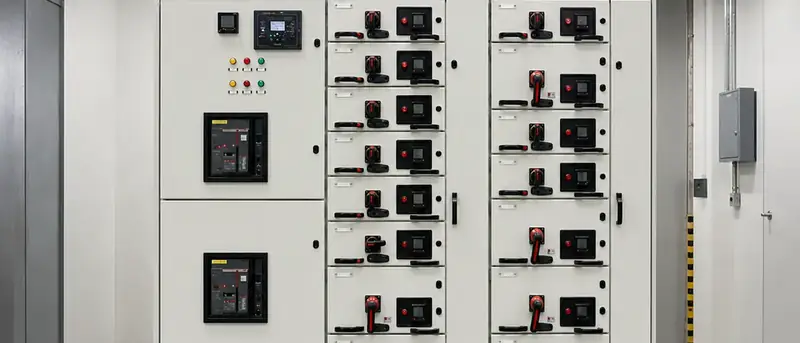
Switchgear vs switchboard is mainly a question of fault withstand and construction. In North American practice, low-voltage switchgear (UL 1558, IEEE C37.20.1) uses compartmentalised, usually draw-out power circuit breakers with short-time ratings of up to 30 cycles. A switchboard (UL 891) groups moulded-case breakers or fused switches with roughly 3-cycle withstand. A panelboard (UL 67) is a smaller, front-access board for branch circuits.
Key takeaways
- The three are different product types in the US and Canada, each built and tested to its own standard. Under the IEC system, all three are "low-voltage switchgear and controlgear assemblies" to IEC 61439.
- Switchgear offers the highest ratings, short-time withstand, compartmentalisation and maintainability, at a higher cost and footprint.
- Switchboards are the common choice for building service entrances and main distribution up to several thousand amperes.
- Panelboards distribute power to branch circuits and are usually limited to 1,200 A.
- Choose based on fault level, selectivity needs, maintenance strategy, continuity of service and space, not on the name.
What is the difference between switchgear, a switchboard and a panelboard?
The table below summarises the typical North American distinctions for low-voltage equipment (600 V class). Figures are typical maximums and design norms, not absolute limits for every product.
| Feature | LV switchgear | Switchboard | Panelboard |
|---|---|---|---|
| Main product standard | UL 1558; IEEE C37.20.1 | UL 891 | UL 67 |
| Typical maximum bus rating | Up to about 6,000 A | Up to about 5,000 A | Up to 1,200 A |
| Main protective devices | Low-voltage power circuit breakers (LVPCBs), usually draw-out | Moulded-case or insulated-case breakers, fusible switches; sometimes power breakers | Bolt-on or plug-in moulded-case breakers |
| Short-circuit withstand basis | Short-time ratings, typically 30 cycles (0.5 s) | About 3 cycles; generally no short-time rating | About 3 cycles |
| Compartmentalisation | Each breaker in its own metal-barriered compartment | Devices grouped in sections, usually without full barriers | Single enclosure, dead front |
| Access | Usually front and rear | Often front-only in modern designs | Front only |
| Mounting | Floor-standing, deep sections | Floor-standing | Wall or surface mounted in a cabinet |
| Typical use | Large industrial plants, data centres, critical facilities, generator paralleling | Service entrance and main distribution in commercial buildings | Lighting and branch-circuit distribution |
| Relative cost and footprint | Highest | Medium | Lowest |
The National Electrical Code (NFPA 70) covers all three in Article 408, and recent editions define switchgear separately from switchboards.
What is LV switchgear?
LV switchgear in the North American sense is "metal-enclosed low-voltage power circuit breaker switchgear". Its defining features are:
- Power circuit breakers. LVPCBs are built to their own standards and are usually draw-out, so they can be racked to a test or disconnected position for maintenance without de-energising the line-up.
- Short-time withstand. Power breakers can carry fault current for a defined short time, typically 30 cycles, without tripping instantaneously. This lets a downstream breaker clear the fault first, which gives full selective coordination.
- Compartmentalisation. Breakers sit in individual metal compartments, and the bus runs through a separate compartment. A fault in one area is less likely to spread.
- Advanced control. Switchgear readily accommodates protection relays, metering, automatic transfer schemes and generator paralleling.
The trade-offs are cost, depth and the need for rear access. Facilities that cannot tolerate an outage, or that need maintenance on one breaker while the rest stays live, usually justify switchgear.
What is an electrical switchboard?
An electrical switchboard is a large, floor-standing assembly of panels that receives power, often directly from a utility transformer, and distributes it to feeders, panelboards and large loads. Switchboards built to UL 891 commonly use:
- a main breaker or fusible switch;
- group-mounted moulded-case or insulated-case breakers for feeders;
- metering, surge protection and, in some designs, automatic transfer switches or integrated panelboard sections.
Because the devices are group-mounted and switchboards generally lack short-time ratings, selective coordination relies more on breaker trip settings and current-limiting devices. Switchboards are smaller and less expensive than switchgear and are the standard choice for most commercial buildings.
Switchboard vs panelboard: where is the line?
A panelboard is the end of the distribution chain. It is designed to be placed in a cabinet or cutout box, accessible only from the front, and feeds branch circuits for lighting, receptacles and small equipment. Main bus ratings are limited to 1,200 A, and protective devices are compact bolt-on or plug-in breakers.
A switchboard sits upstream. It handles higher currents, is free-standing rather than wall-mounted, and feeds panelboards and large loads. Some switchboards include panelboard sections, which is one reason the terms get mixed up on drawings.
A practical test: if the equipment mounts on a wall with a hinged door and feeds branch circuits, it is a panelboard. If it stands on the floor and feeds other distribution equipment, it is a switchboard or switchgear.
How does the IEC world classify the same equipment?
Outside North America, low-voltage assemblies follow the IEC 61439 series. Instead of separate product types, IEC 61439 defines a single framework of design verification and routine verification, with parts for:
- IEC 61439-2: power switchgear and controlgear assemblies (PSC-assemblies), the equivalent of switchgear and switchboards, including main distribution boards and motor control centres;
- IEC 61439-3: distribution boards intended to be operated by ordinary persons (DBO), the closest equivalent to panelboards.
The differences that North American standards express through product type are expressed under IEC 61439 through ratings and construction choices:
| IEC 61439 characteristic | What it tells you | Closest North American concept |
|---|---|---|
| Rated short-time withstand current (Icw) and duration | Ability of the busbars to carry fault current for a time, enabling time-delayed selectivity | Short-time rating of switchgear |
| Rated conditional short-circuit current (Icc) | Withstand when protected by a specified current-limiting device | Series or fuse-protected ratings |
| Form of internal separation (Form 1 to Form 4) | How busbars, functional units and terminals are segregated | Compartmentalisation |
| Withdrawable or fixed functional units | Whether a feeder can be removed while others stay live | Draw-out construction |
| Rated current of the assembly (InA) | The total current the assembly can distribute | Bus rating |
So a high-specification LV panel with Form 4 separation, withdrawable functional units, air circuit breakers and a high Icw rating performs much like North American switchgear. Designs such as GCS and MNS withdrawable boards fall into this category. A simple Form 1 distribution board with fixed moulded-case breakers is closer to a switchboard or panelboard.
Which one should you specify?
Work through these questions in order:
- What is the prospective fault level? Calculate it from the supply transformer rating and impedance. Our transformer calculator gives full-load currents for standard sizes, and our guide to sizing a distribution transformer explains the impedance step.
- Do you need full selective coordination? Critical loads and some code requirements favour equipment with short-time ratings.
- How will you maintain it? Draw-out units let you service one feeder while the rest of the board stays live.
- What standard applies at the site? A project in North America will usually need UL-listed equipment. Elsewhere, IEC 61439 verification is the norm.
- How much space is available? Switchgear needs more depth and usually rear access.
Toppower Asia supplies IEC 61439-based LV assemblies, including a GCS draw-out LV distribution switchboard rated 1 kV, 1,600 A, a multi-voltage 400–480 V withdrawable LV switchboard and a motor control centre and main distribution cabinet. Confirm at enquiry stage which standard and listing your project requires. The Mexico 13.8 kV/480 V automotive factory substation application example shows where an LV board fits in a complete package. For background on the wider family, read what is electrical switchgear.
Frequently asked questions
Is a switchboard the same as switchgear?
Not in North America, where they are built to different standards (UL 891 for switchboards, UL 1558 and IEEE C37.20.1 for LV switchgear) and switchgear has compartmentalised power breakers with short-time ratings. In IEC countries the words are often used interchangeably for LV assemblies to IEC 61439, so check the ratings rather than the name.
What is an LV panel?
"LV panel" is a general term for a low-voltage distribution assembly, usually 400 V or 480 V. It may be a main distribution board, a sub-distribution board, a motor control centre or a capacitor bank panel. Its capability is defined by its ratings, form of separation and devices, not by the label.
What is the maximum rating of a panelboard?
Under UL 67 and North American practice, panelboards are generally limited to a main bus rating of 1,200 A at 600 V or below. Larger services use switchboards or switchgear.
Why does switchgear cost more than a switchboard?
It uses power circuit breakers with draw-out mechanisms, full metal compartmentalisation, heavier busbars braced for short-time withstand and more space. The extra cost buys selectivity, maintainability and continuity of service.
Do I need switchgear or a switchboard for a data centre?
Many data centres choose switchgear for main distribution because of high fault levels, generator paralleling and the need for maintenance without shutdowns. Smaller or less critical facilities may use switchboards. The decision should follow a coordination study and the owner's maintenance strategy.
If you are deciding between LV switchgear and a switchboard for a plant or building, send us your single-line diagram, fault level and applicable standards and our engineering team will prepare a technical proposal for the right assembly.