Arc flash and internal arc classification (IAC) in switchgear

An arc flash study calculates the incident energy a worker could receive at each piece of electrical equipment if an arc fault occurred, using the IEEE 1584 method, and sets arc flash boundaries, labels and PPE under NFPA 70E. Internal arc classification (IAC) to IEC 62271-200, or arc-resistant ratings to IEEE C37.20.7, show that switchgear can contain and redirect an internal arc with its doors closed. Both are needed: the study quantifies the hazard, the equipment rating reduces exposure.
Key takeaways
- An arc flash study is a calculation, not a test. It depends on the network model, fault levels and protection clearing times.
- IEEE 1584 gives the incident energy calculation method; NFPA 70E sets how the results are used for risk assessment, boundaries, labels and PPE.
- IAC (for example IAC AFLR 25 kA 1 s) and IEEE C37.20.7 types describe tested switchgear performance with doors and covers closed and secured.
- Arc-resistant switchgear does not make open-door work safe. Remote racking, fast protection and good procedures are still required.
- Specify the IAC class, test current and duration, and the gas exhaust arrangement together with the switchgear rating.
What is an arc flash?
An arc flash is the release of energy from an electric arc between phases, or between a phase and earth, through air. The arc produces intense heat, light, pressure, sound and molten metal. Typical causes include dropped tools, insulation failure, contamination, animals and incorrect operation.
The thermal effect on a person is expressed as incident energy at a working distance, in cal/cm² or J/cm². The pressure wave and ejected material are separate hazards; they are not captured by incident energy alone, which is one reason equipment design matters.
What does an arc flash study include?
An arc flash study, also called an incident energy analysis, is normally done by a qualified electrical engineer with power system analysis software. The typical sequence:
- Collect data. Utility fault level, transformer ratings and impedances, cable lengths and sizes, generator and motor data, protective device types and settings, and equipment enclosure types.
- Build the network model and confirm the single-line diagram matches the installation.
- Run short-circuit calculations to find bolted fault current at each bus.
- Run a protection coordination review to determine how long each device takes to clear an arcing fault.
- Calculate arcing current and incident energy at each location using IEEE 1584.
- Determine the arc flash boundary, the distance at which incident energy falls to 1.2 cal/cm² (5.0 J/cm²), the level associated with the onset of a second-degree burn.
- Produce labels and a report, including recommendations to reduce incident energy.
The study should be repeated or reviewed when the system changes. NFPA 70E requires the incident energy analysis to be reviewed for accuracy at intervals not exceeding five years.
How does IEEE 1584 calculate incident energy?
IEEE 1584-2018 is an empirical model built from extensive laboratory testing. It covers three-phase AC systems from 208 V to 15 kV and takes into account system voltage, bolted fault current, gap between conductors, working distance, enclosure size and electrode configuration (for example vertical conductors in a box, horizontal conductors in a box, or open air). Arc duration, which comes from the protective device clearing time, has a direct effect on the result: halving the clearing time roughly halves the incident energy.
What does NFPA 70E require?
NFPA 70E is the US standard for electrical safety in the workplace. For arc flash, it requires an arc flash risk assessment before work on or near exposed energised parts, the use of either the incident energy analysis method or the PPE category method to select protective equipment, equipment labelling, and training. It also sets a hierarchy of risk controls in which elimination (working de-energised) comes first and PPE comes last.
Outside the USA, national regulations apply, but IEEE 1584 is widely used for studies. This article is technical guidance only; check the legal requirements that apply to your site with a qualified local engineer.
What is internal arc classification (IAC)?
Internal arc classification is an optional rating for metal-enclosed medium-voltage switchgear and controlgear under IEC 62271-200. It is assigned after a type test in which an arc is deliberately ignited inside each relevant compartment while indicators (cotton cloth panels) are placed around the switchgear at defined distances, representing a person standing nearby.
The switchgear passes if, among other criteria:
- correctly secured doors and covers do not open
- no fragmentation of the enclosure occurs and no heavy parts are projected (small parts under the defined mass limit are allowed)
- the arc does not burn holes in the accessible sides up to the specified height
- the indicators do not ignite from hot gases
- the enclosure remains connected to its earthing point
What does IAC AFLR mean?
The designation describes the conditions under which the switchgear was tested:
| Code | Meaning |
|---|---|
| A | Accessibility type A: access restricted to authorised personnel only |
| B | Accessibility type B: unrestricted access, including the general public |
| F | Front side tested as accessible |
| L | Lateral (side) faces tested as accessible |
| R | Rear side tested as accessible |
| kA value | Arc fault test current, normally related to the rated short-time withstand current |
| Time value | Arc duration, for example 0.1 s, 0.5 s or 1 s |
So "IAC AFLR 25 kA 1 s" means the switchgear protected people standing at the front, sides and rear, in an area accessible to authorised personnel, during a 25 kA internal arc lasting one second. "IAC AF" would cover only the front, which may be acceptable if the switchgear is installed against a wall with no access behind.
For prefabricated substations, IEC 62271-202 defines internal arc classes (IAC-A and IAC-B) for the whole substation. For low-voltage assemblies, IEC TR 61641 describes an arcing test under internal fault conditions.
How does IEEE C37.20.7 compare?
IEEE C37.20.7 is the North American guide for testing metal-enclosed switchgear for internal arcing faults. It uses accessibility types:
| Type | Protected areas |
|---|---|
| 1 | Freely accessible front only |
| 2 | Front, back and sides |
| Suffix B | Also with low-voltage, control or instrument compartment doors open |
| Suffix C | Adds isolation between adjacent compartments |
| Suffix D | Type 1 with specified additional surfaces evaluated |
The pass criteria are similar in principle to IEC 62271-200. The two are not interchangeable labels, so specify the one your project standard and authority require.
How does arc resistant switchgear reduce risk?
Arc-resistant or IAC-rated switchgear is designed to withstand the pressure rise of an internal arc and to direct hot gases away from people. Common design features:
- reinforced doors, hinges and latches
- pressure relief flaps on top of each compartment
- gas exhaust ducts or plenums leading out of the room or to a safe area
- metal partitions between busbar, circuit breaker and cable compartments
- shutters over the fixed contacts when the circuit breaker is withdrawn
- interlocks that prevent opening the door until the circuit is safe
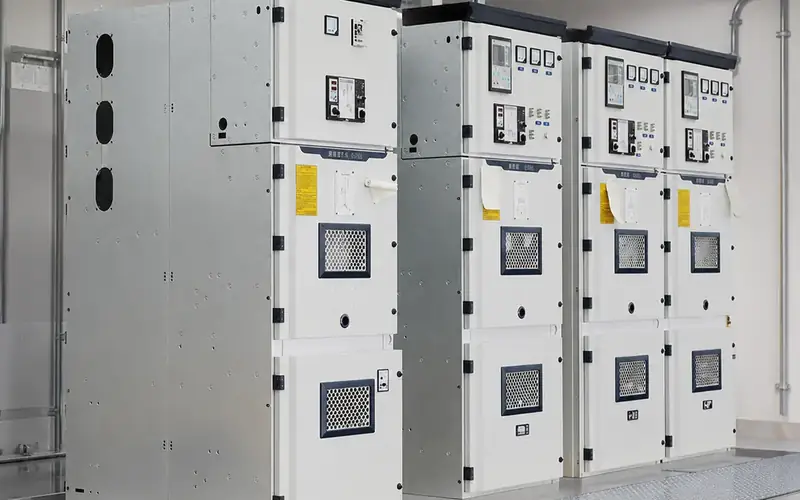
Metal-clad, withdrawable designs such as our KYN28A-12 draw-out switchgear and the indoor metal-clad switchgear for 12 kV, 24 kV and 35 kV use compartment separation of this kind. Always ask for the IAC type test report for the exact configuration offered, since ratings depend on panel width, compartment and exhaust arrangement. The wider construction options are explained in our medium voltage switchgear guide.
What IAC does not do
IAC applies in normal operating condition, with doors and covers closed and secured. It does not reduce incident energy when a door is open for maintenance, during testing, or on equipment with removed covers. It also depends on the room: ceiling height, exhaust routes and wall distances must match the conditions tested. The arc flash study still determines the PPE needed for tasks that expose workers.
Which arc flash protection measures work best together?
| Measure | How it helps | Typical application |
|---|---|---|
| De-energise before work | Removes the hazard | All tasks where practical |
| IAC or arc-resistant switchgear | Contains the arc with doors closed | MV switchgear rooms, public areas |
| Arc flash detection relays (light plus current) | Trip in a few milliseconds, reducing arc duration | MV and LV main switchboards |
| Maintenance mode or reduced settings | Temporary faster tripping during work | LV breakers, MV relays |
| Zone-selective interlocking or bus differential protection | Fast clearing without losing coordination | Main buses |
| Remote racking and remote operation | Moves the worker away from the equipment | Withdrawable breakers |
| Current-limiting fuses | Limit arcing current and time | LV feeders, RMU transformer protection |
| Correct PPE | Last line of defence | Tasks with remaining exposure |
Ring main units with fused transformer protection, such as the sealed SF6 ring main unit for 12 kV and 24 kV, are often installed in public areas where accessibility type B matters. Our article on SF6 vs solid-insulated ring main units covers those options.
How do you specify internal arc classification?
Include these points in the switchgear specification:
- standard: IEC 62271-200 (or IEEE C37.20.7 for North American projects)
- accessibility type and sides: for example IAC AFLR, or IAC AFL for wall-mounted lineups
- arc fault current and duration, consistent with the network fault level and the protection clearing time
- gas exhaust method: into the room, via duct to outside, or through a plenum, with room dimensions
- type test report for the configuration offered
- interlocks, shutters and remote racking if required
Review this together with the arc flash study, so equipment rating, protection settings and working procedures support each other. If you are new to the equipment categories, start with what is electrical switchgear.
Frequently asked questions
What is an arc flash study and who should do it?
It is an engineering analysis that calculates incident energy and arc flash boundaries at each piece of equipment, based on a model of the electrical system. It should be carried out by a qualified electrical engineer with access to accurate system data and protection settings.
Does arc resistant switchgear eliminate the need for an arc flash study?
No. An internal arc rating shows how equipment behaves with doors closed during a tested fault. The study is still needed to determine boundaries, labels and PPE for tasks where workers are exposed, such as racking with doors open or testing.
What is the difference between IAC A and IAC B?
Type A means the switchgear was tested for locations accessible only to authorised personnel. Type B means it was tested for locations accessible to the general public, with stricter indicator placement. Choose B for kiosks and installations where the public can stand next to the equipment.
Is a higher internal arc test current always better?
The test current and duration should match or exceed the prospective fault current and the protection clearing time at the installation. Specifying far beyond the network fault level adds cost without a matching benefit.
How can arc flash protection be improved on existing equipment?
Common steps are faster protection (arc flash detection relays, maintenance mode settings, bus differential protection), remote racking, current-limiting fuses and updated procedures. Each change should be checked by updating the arc flash study.
Send us your switchgear requirements
Send your single-line diagram, fault levels and required internal arc classification, and our engineers will review them and return a technical proposal with type test documentation for the configuration offered. Contact our engineering team.