Transformer noise: why transformers hum and how to limit it
Transformer noise is mainly a low-pitched hum at twice the supply frequency (100 Hz on 50 Hz systems, 120 Hz on 60 Hz systems), caused by magnetostriction in the core, electromagnetic forces in the windings and, on larger units, cooling fans and pumps. You limit it by specifying a guaranteed sound level, choosing a lower flux density and good core construction, and planning the installation so sound is not amplified or transmitted.
Key takeaways
- Transformer hum has three sources: core (no-load) noise, winding (load) noise and cooling equipment noise.
- Sound power level is a property of the transformer; sound pressure level depends on distance, the room and other surfaces. Specify which one you mean.
- IEC 60076-10 defines how sound levels are measured; NEMA TR 1 is the North American reference for typical sound levels by rating.
- Lower noise usually means lower flux density, more core steel and higher cost, so set a realistic limit based on the site.
- Installation matters as much as design: anti-vibration pads, flexible connections and room acoustics can make or break a quiet site.
Why do transformers hum?
Core noise (no-load noise)
When alternating flux magnetises the core, the electrical steel changes length very slightly. This effect, magnetostriction, happens twice in each cycle, so the fundamental vibration frequency is twice the supply frequency. Because the steel's response is non-linear, harmonics at 200, 300 and 400 Hz (or 240, 360, 480 Hz) are also present, which is why transformer hum can sound harsher than a pure tone.
Core noise is present whenever the transformer is energised, even with no load, and rises with flux density. It also depends on core joint design, clamping pressure and the grade of steel.
Winding noise (load noise)
Load current in the windings creates electromagnetic forces between conductors and between windings. These forces also vary at twice the supply frequency, and their magnitude rises with the square of current. Load noise is small in most distribution transformers but can become significant in large power transformers, especially low-loss designs where core noise has already been reduced.
Cooling equipment noise
Fans on ONAF or AF units and pumps on forced-oil units add broadband noise. A transformer that is quiet at its ONAN rating can be several decibels louder when the fans start. If the site has a night-time noise limit, check the sound level for each cooling stage.
Other contributors
Loose panels, accessories, cable boxes or enclosures can resonate and amplify the hum. Harmonic currents from drives and inverters add higher-frequency components. DC bias in the core, for example from geomagnetic currents or some converter configurations, can raise noise noticeably.
How is transformer sound level measured?
IEC 60076-10, "Power transformers – Part 10: Determination of sound levels" (edition 2.0, 2016), defines sound pressure and sound intensity measurement methods to determine the sound power level of transformers, reactors and their cooling devices. It is mainly a factory test but can be applied on site where conditions allow.
In outline, measurements are taken on a contour around the transformer at a defined distance, with the unit energised at rated voltage and frequency. Background noise is measured before and after, and corrections are applied. The result is reported as an A-weighted sound power level, LWA, and the average sound pressure level at the contour.
Under IEC 60076-1, sound level determination is a type test. It can be specified on your unit if no report exists for the design. Load noise measurement is a separate step, usually only requested for larger transformers.
In North America, the measurement method is in IEEE C57.12.90 (liquid-immersed) and IEEE C57.12.91 (dry-type), and NEMA TR 1 gives typical average sound levels by kVA rating, voltage class and cooling. Many specifications quote a limit as "NEMA TR 1 minus x dB". Use the current edition of the document as your reference rather than values copied from older specifications.
What is the difference between sound power and sound pressure?
This is the most common source of confusion in noise specifications.
| Quantity | Symbol | What it describes | Depends on |
|---|---|---|---|
| Sound power level | LWA, dB(A) | Total acoustic energy radiated by the transformer | The transformer only |
| Sound pressure level | LpA, dB(A) | What a microphone or listener measures at a point | Distance, room, reflections, background noise |
| Sound intensity | LI | Directional energy flow, used to separate transformer noise from background | Measurement position |
A sound power value lets you compare transformers and calculate the expected level at a boundary or window. A sound pressure value without a distance is meaningless. When you set a limit, state "sound power level LWA not exceeding x dB(A)" or "average sound pressure level at 0.3 m (or 1 m) not exceeding y dB(A) measured to IEC 60076-10".
In open field conditions, sound pressure from a compact source falls by about 6 dB for each doubling of distance. Close to a large transformer the reduction is smaller, and walls or buildings reflect sound back, so environmental predictions need an acoustic calculation.
Are dry-type transformers louder than oil-immersed ones?
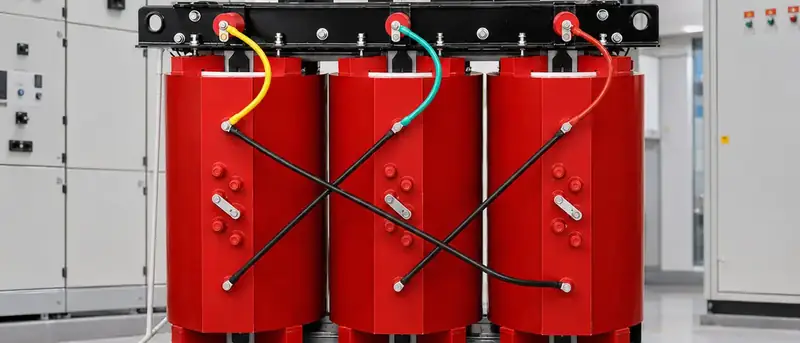
Often, yes, for the same rating. In an oil-immersed transformer, the oil and tank damp part of the core vibration. A cast-resin dry-type transformer radiates core and coil vibration directly to the air, and it is usually installed indoors, where the room reflects sound.
That does not mean dry-type units are always unsuitable for noise-sensitive buildings. Lower flux density, careful core construction and good installation can bring a cast-resin unit to an acceptable level. Products such as our quiet-running dry distribution transformer or the toroidal-coil low-noise resin dry transformer are examples of designs aimed at indoor sites. The wider trade-offs are covered in dry-type vs oil-immersed transformers.
How can transformer noise be reduced in the design?
Noise reduction is a design choice with cost consequences. The main levers:
| Measure | Effect on noise | Trade-off |
|---|---|---|
| Lower core flux density | Reduces magnetostriction, typically the largest single lever | More core steel, larger and heavier unit, higher price |
| High-grade grain-oriented steel | Lower magnetostriction and losses | Material cost |
| Step-lap core joints | Smoother flux transfer at joints, lower noise and no-load loss | Manufacturing effort |
| Correct core clamping and bonding | Reduces vibration and rattling | Process control |
| Anti-vibration mounting of the active part | Less vibration transferred to the tank | Design complexity |
| Tank stiffeners or sound panels | Damp tank resonance | Weight, cost |
| Low-speed fans | Lower cooling noise | More fans or larger radiators |
| Sound enclosure | Large reduction for oil units | Cost, maintenance access, cooling |
Lower flux density also reduces no-load loss, so a low-noise specification can support efficiency targets. Our article on transformer losses and efficiency regulations explains how core losses are regulated.
How can you reduce transformer hum on site?
Many noise complaints come from installation rather than the transformer itself. Before the unit arrives:
- Choose the location. Keep transformers away from bedrooms, offices and shared walls. Avoid room corners, which reinforce low-frequency sound.
- Isolate vibration. Use anti-vibration pads or mounts suited to the weight, and avoid rigid contact between the transformer base and the building structure.
- Use flexible connections. Flexible busbar links or cable connections stop vibration travelling into busducts and switchgear.
- Treat the room. Absorptive panels reduce reverberation in transformer rooms. Ventilation openings need acoustic louvres if they face sensitive areas.
- Tighten everything. Check enclosure panels, covers and accessories for rattles after energisation.
- Control harmonics and voltage. Operating above rated voltage raises flux density and noise; check the tap position and harmonic content.
For outdoor units near residential areas, a barrier wall or enclosure may be more economical than a special low-noise design. For packaged substations, the enclosure itself affects noise; see our transformer substations for typical enclosure options.
What sound level should you specify?
Start from the requirement at the receiver: the local environmental limit at the property boundary, or the acceptable level inside an adjoining room. Work back, with an acoustic calculation, to the maximum sound power level of the transformer. Then:
- state the limit as sound power level or as average sound pressure at a defined distance
- name the measurement standard (IEC 60076-10, or IEEE C57.12.90 / C57.12.91)
- state the cooling stage at which the limit applies
- ask for the sound level type test report, or a test on your unit
- include the limit in the guaranteed values of the data sheet, as listed in our transformer RFQ checklist
Avoid asking for the lowest possible noise without a reason. Each decibel of reduction costs core material, and an unnecessary limit can raise price and weight with no benefit.
Frequently asked questions
Is transformer hum normal?
Yes. A steady hum at twice the supply frequency is normal for any energised transformer. A change in the sound, such as new buzzing, crackling or rattling, should be investigated, since it can indicate loose parts, overvoltage, DC bias or a developing fault.
What is NEMA TR 1?
NEMA TR 1 is a North American document that lists typical average sound levels for transformers, reactors and regulators by rating and type. Specifications often use it as a baseline, for example requiring a level a stated number of decibels below the NEMA TR 1 value.
Does transformer noise increase with load?
Core noise depends mainly on voltage and is almost constant with load. Winding noise rises with load current, and fans start at higher loads on forced-cooled units. On distribution transformers, the overall increase from no load to full load is usually small; on large power transformers it can be noticeable.
How is transformer sound level tested?
Under IEC 60076-10, microphones or an intensity probe are placed on a contour around the transformer while it is energised at rated voltage. Background noise is measured and corrected, and the result is reported as an A-weighted sound power level.
Can an old transformer become louder?
Yes. Loosening of core clamping, failed anti-vibration pads, loose panels and changes in operating voltage or harmonic content can all increase noise. A sound measurement compared with the factory test result helps identify the cause.
Ask for a low-noise proposal
Tell us the site, the noise limit and the measurement point, and send your single-line diagram or data sheet. Our engineers will propose a transformer design and installation measures that meet the requirement without overspecifying. Contact our engineering team.