Transformer oil: types, tests and maintenance

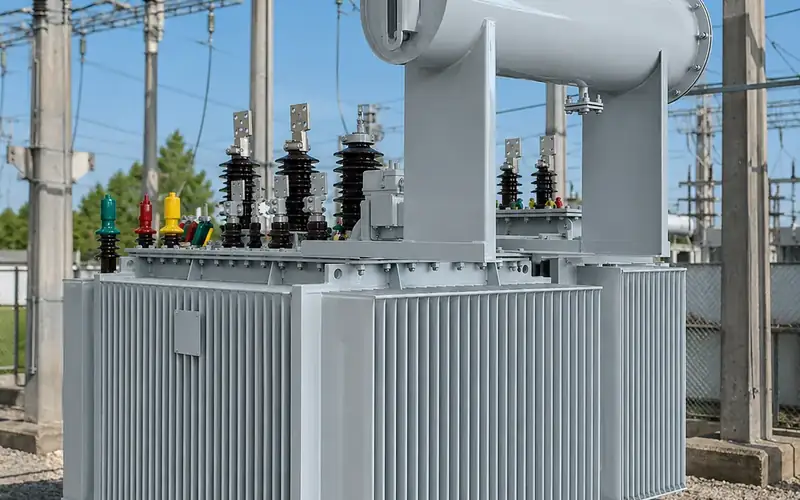
Transformer oil is the insulating and cooling liquid in an oil-immersed transformer. It fills the tank, impregnates the paper insulation, carries heat from the windings to the radiators and, through dissolved gas analysis, reports on the transformer's internal condition. Most units use mineral insulating oil to IEC 60296; natural and synthetic ester fluids are used where fire safety or biodegradability matters. Regular tests of breakdown voltage, moisture, acidity and dissolved gases keep the oil, and the transformer, healthy.
Key takeaways
- Transformer oil does three jobs: insulation, cooling and condition monitoring.
- Mineral oil (IEC 60296) is the default. Natural esters (IEC 62770) and synthetic esters (IEC 61099) have much higher fire points and are readily biodegradable, at higher cost.
- The core oil tests are breakdown voltage, water content, acidity, dielectric dissipation factor, interfacial tension and DGA.
- Moisture is the main enemy: it lowers breakdown voltage and accelerates paper ageing.
- Supervision and maintenance of mineral oil is guided by IEC 60422; DGA interpretation by IEC 60599 or IEEE C57.104.
What does transformer oil do?
Insulation. Oil has a far higher dielectric strength than air, and it fills the spaces between windings, leads and the tank. Together with cellulose paper and pressboard, it forms the oil-paper insulation system that lets an 11 kV or 110 kV transformer be compact.
Cooling. Load and core losses heat the windings. Oil absorbs that heat and circulates, by natural convection (ONAN) or with pumps (OF, OD), to radiators or coolers where air removes it.
Diagnostics. Faults such as overheating, partial discharge and arcing decompose oil and paper into characteristic gases that dissolve in the oil. A small oil sample can therefore show a developing fault months before it becomes a failure.
Oil also protects the core steel and copper from oxidation, and in a sealed design it is isolated from air entirely.
What types of transformer insulating oil are there?
| Property | Mineral oil | Natural ester | Synthetic ester |
|---|---|---|---|
| Specification | IEC 60296 | IEC 62770 | IEC 61099 |
| Base | Refined petroleum (naphthenic or isoparaffinic, including gas-to-liquid) | Vegetable oils (e.g. rapeseed, soybean) with additives | Engineered polyol esters |
| Typical fire point | Roughly 160 to 170 °C | Above 300 °C (around 350 °C typical) | Above 300 °C |
| Fire class (IEC 61039) | O (fire point ≤ 300 °C) | K (fire point > 300 °C) | K |
| Biodegradability | Low | Readily biodegradable | Readily biodegradable |
| Moisture tolerance | Low; water saturates at low ppm | High; absorbs much more water and draws it from paper | High |
| Oxidation stability | Good, especially inhibited grades | Lower; best in sealed transformers | Very good; suits free-breathing designs |
| Viscosity | Low | Higher; affects cooling design | Higher |
| Relative cost | Lowest | Higher | Highest |
| Typical use | Most distribution and power transformers | Indoor, urban, pad-mounted, environmentally sensitive sites | Traction, offshore, high-reliability and retrofill cases |
The 2020 edition of IEC 60296 classifies new mineral oils into two performance groups, Type A (the higher-performance group, with stricter requirements such as oxidation stability) and Type B, and also covers recycled oils. Specify the type, and confirm the oil is free of PCBs and corrosive sulphur.
Mineral oil is the default for cost, availability and decades of service experience. It is the fill for most units in our oil-immersed transformer range.
Natural ester fluid is made from vegetable oil. Its high fire point can reduce fire separation and containment requirements in many codes, and it is readily biodegradable, which helps near water courses. It also tolerates moisture better and has been shown to slow paper ageing. Because it oxidises more readily in contact with air, it is best used in sealed transformers. Higher viscosity means the cooling design must be checked, not just the fluid swapped.
Synthetic ester shares the high fire point and biodegradability of natural esters and has better oxidation stability, at a higher price.
If you are choosing between a fire-safe liquid and a dry-type unit for an indoor room, read dry-type vs oil-immersed transformers first.
Which transformer oil tests matter most?
A routine oil analysis covers physical, chemical and electrical properties, plus DGA.
| Test | What it tells you | Common method |
|---|---|---|
| Breakdown voltage (BDV) | Contamination by water and particles | IEC 60156; ASTM D1816 or D877 |
| Water content | Moisture in oil, and indirectly in paper | IEC 60814 (Karl Fischer) |
| Acidity (neutralisation number) | Oxidation by-products; sludge risk | IEC 62021 |
| Dielectric dissipation factor (tan δ) | Polar contaminants and ageing | IEC 60247 |
| Interfacial tension | Early sign of polar ageing products | IEC 62961 |
| Colour and appearance | Visual check for sludge, particles, cloudiness | Visual / ISO 2049 |
| Inhibitor content | Remaining oxidation inhibitor in inhibited oil | IEC 60666 |
| Furanic compounds | Paper degradation, linked to degree of polymerisation | IEC 61198 |
| Dissolved gas analysis (DGA) | Thermal and electrical faults inside the tank | IEC 60567 sampling and extraction; IEC 60599 or IEEE C57.104 interpretation |
| Corrosive sulphur | Risk of copper sulphide deposits on windings | IEC 62535 |
Always sample in clean, dry containers from the bottom drain valve, record the oil temperature, and send samples to a laboratory promptly. Poor sampling is the most common reason for a bad result.
What is a good breakdown voltage for transformer oil?
Breakdown voltage (BDV) is the voltage at which oil between two standard electrodes fails. It is the quickest indicator of water and particles, but it does not detect chemical ageing, so it is never used alone.
The value depends on the test method. IEC 60156 uses a 2.5 mm gap. ASTM D1816 uses shaped electrodes at 1 mm or 2 mm, and ASTM D877 uses disc electrodes, so numbers from different methods are not directly comparable.
As a cautious guide using the IEC method:
- New oil as delivered to IEC 60296 must meet at least 30 kV, rising to 70 kV after laboratory drying and filtration.
- New oil in a new transformer before energisation is commonly expected to exceed about 55 kV for equipment below 72.5 kV and about 60 kV for higher voltage classes.
- In-service oil action limits in IEC 60422-based maintenance practice sit lower and depend on voltage class, roughly 30 to 40 kV for distribution transformers and higher for transmission equipment.
Check the current edition of IEC 60422 (Edition 5.0 was published in 2024) and your utility or owner's specification for the exact limits that apply. A falling trend matters more than a single reading.
What does dissolved gas analysis (DGA) show?
DGA measures gases such as hydrogen (H2), methane (CH4), ethane (C2H6), ethylene (C2H4), acetylene (C2H2), carbon monoxide (CO) and carbon dioxide (CO2). Each fault type produces a characteristic mix:
- Partial discharge: mainly hydrogen.
- Low-temperature thermal fault: methane and ethane.
- High-temperature thermal fault (above about 700 °C): ethylene, with some acetylene at the highest temperatures.
- Arcing: acetylene and hydrogen.
- Overheated paper: carbon monoxide and carbon dioxide.
IEC 60599 uses gas ratios and the Duval triangle to classify faults. IEEE C57.104 (2019 revision) uses gas levels, rates of increase and a status-based approach. Both stress that the rate of change is often more important than the absolute value. A baseline DGA taken at commissioning, and on large units in the factory, makes later results meaningful. Ester fluids produce somewhat different gas patterns, so use interpretation methods adapted for them.
How do you maintain transformer oil?
A practical maintenance sequence:
- Sample on a schedule. Many owners test distribution units every few years and large power transformers at least annually, with more frequent DGA on critical or suspect units. Online DGA monitors are common on large units.
- Trend the results. Compare each test with the previous ones and with the commissioning baseline.
- Dry and filter when BDV falls or water rises. Vacuum dehydration plants remove water, gas and particles, and can often be run with the transformer in service.
- Reclaim oil with high acidity or low interfacial tension, using adsorbent (Fuller's earth) treatment that removes polar ageing products. Add inhibitor afterwards if the oil is an inhibited type.
- Replace oil when treatment is uneconomic, or retrofill with an ester fluid where fire risk needs to fall, following the transformer designer's advice on compatibility and cooling.
- Fix the cause. Leaking gaskets, saturated breathers and failed seals let water in faster than any plant can remove it.
For transformers with a conservator, keep the silica gel breather active and check the Buchholz relay. Sealed designs, such as our hermetically sealed 10 kV distribution transformers, avoid air contact entirely and need less oil maintenance. The parts involved are explained in parts of a transformer.
At commissioning, an oil BDV test is part of the site checks, alongside the factory results described in transformer routine tests before shipment.
Frequently asked questions
Can mineral oil and natural ester be mixed?
They are miscible, and small residues of mineral oil remain after a retrofill. But mixing changes the fire point, so a mixture may not keep the K-class rating of a pure ester. Retrofilling should follow a defined procedure with flushing, and the residual mineral oil content should be kept low.
Why is moisture so harmful in transformer oil?
Water lowers breakdown voltage, and at high temperatures it can form bubbles from wet paper during overload. It also accelerates the chemical ageing of cellulose insulation, which determines transformer life. Most water sits in the paper, not the oil.
How often should transformer oil be tested?
It depends on size, criticality and condition. Small distribution units are often tested every few years or after events; power transformers are usually sampled at least once a year, with DGA more often if results trend upwards. IEC 60422 and IEEE C57.106 give guidance on frequencies.
Does transformer oil need to be PCB-free?
Yes. Polychlorinated biphenyls are banned under the Stockholm Convention, and new oil must contain no detectable PCBs. When buying used equipment or treating old oil, test for PCBs before any work.
Is a natural ester transformer worth the extra cost?
Where fire separation, insurance, water-course protection or indoor installation drive costs, often yes, because the high fire point and biodegradability can reduce civil works. For an outdoor rural substation with plenty of space, mineral oil is usually the economic choice.
Specify the right transformer fluid
Tell us your site, installation type and fire or environmental requirements, and we will propose mineral oil or ester-filled designs with the matching cooling and test scope. Send your single-line diagram or data sheet to our engineering team.