Vacuum vs SF6 circuit breakers for medium voltage
A vacuum circuit breaker interrupts current inside a sealed vacuum bottle, where the arc burns in metal vapour and dies at current zero; an SF6 circuit breaker extinguishes the arc by blowing sulphur hexafluoride gas across it. At medium voltage (roughly 3.6 kV to 40.5 kV), vacuum is now the standard choice. SF6 remains common at transmission voltages, though both technologies are evolving.
Key takeaways
- Vacuum circuit breakers dominate new medium voltage circuit breaker installations: they are compact, need little maintenance and contain no greenhouse gas.
- SF6 breakers interrupt in a pressurised gas using puffer or self-blast designs and have long been the standard above 52 kV.
- Both are rated and type-tested to IEC 62271-100 (or IEEE C37 standards in ANSI markets); compare ratings, endurance classes and restrike classes, not just technology.
- Vacuum breakers can create switching overvoltages on some inductive loads, which are managed with surge arresters or RC snubbers.
- At low voltage, the equivalent device for main incomers is the air circuit breaker, which interrupts in open air with arc chutes.
How does a vacuum circuit breaker work?
The heart of a vacuum circuit breaker is the vacuum interrupter: a ceramic body sealed at very low internal pressure, with one fixed and one moving contact. A metal bellows lets the moving contact travel a few millimetres without breaking the seal.
When the contacts separate under load, the current continues to flow through an arc formed from metal vapour boiled off the contact surfaces. There is no gas to ionise, so as the alternating current approaches its natural zero, the vapour condenses on the contacts and shield within microseconds and the gap recovers its dielectric strength very quickly. The arc does not re-ignite and the circuit is open.
Contact design matters. Copper-chromium contacts with radial or axial magnetic field geometry keep the arc spread over the contact face, which limits erosion at high fault currents. The operating mechanism, usually a spring-charged or magnetic actuator type, provides the short stroke and contact pressure.
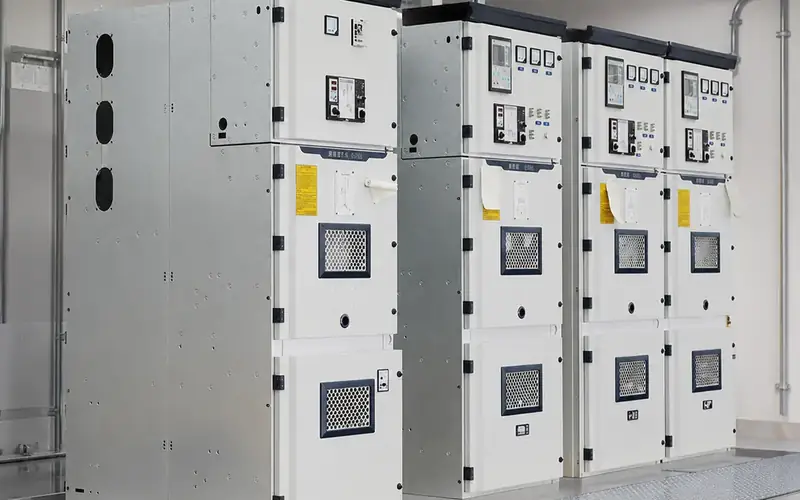
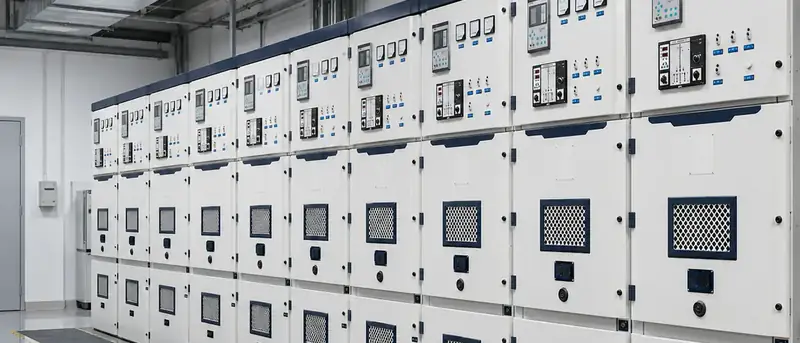
In metal-clad switchgear, the breaker is usually mounted on a withdrawable truck. Our KYN28A-12 draw-out switchgear and the KYN28 metal-clad main switchboard up to 33 kV both use vacuum breakers of this kind.
How does SF6 breaker operation work?
SF6 is an electronegative gas: it captures free electrons, which gives it high dielectric strength and excellent arc-quenching properties. In an SF6 circuit breaker, the contacts sit in a sealed chamber filled with SF6 at a few bar.
Two main designs are used:
- Puffer type. The moving contact drives a piston that compresses gas and blows it through a nozzle across the arc as the contacts part. The arc is cooled and stretched until it extinguishes at current zero. The mechanism must supply the compression energy, so it is relatively powerful.
- Self-blast (thermal-assisted) type. The heat of the arc itself raises the pressure in an expansion volume, and that gas is released across the arc near current zero. A small auxiliary puffer handles low currents. This reduces the mechanism energy needed.
A gas density monitor supervises the chamber. If density falls below a set level, it raises an alarm and then blocks operation, because the breaker can no longer guarantee its ratings.
How do vacuum and SF6 circuit breakers compare?
| Criterion | Vacuum circuit breaker | SF6 circuit breaker |
|---|---|---|
| Interrupting medium | Vacuum inside a sealed interrupter | SF6 gas at a few bar |
| Main voltage range in current practice | Medium voltage; increasingly offered at some ratings above 52 kV | Medium voltage (declining) and most transmission voltages |
| Contact stroke and mechanism energy | Short stroke, low energy | Longer stroke; puffer types need more energy |
| Mechanical and electrical endurance | High; many designs reach the M2 and E2 classes of IEC 62271-100 | Good; depends on design and duty |
| Maintenance | Low; interrupter is sealed for life, mechanism lubrication and checks | Low to moderate; gas density monitoring, periodic gas checks, mechanism maintenance |
| Condition monitoring | Contact erosion indication, vacuum integrity tests during outages | Continuous gas density monitoring |
| Switching overvoltages | Possible current chopping and re-ignitions on inductive loads | Generally softer interruption of small inductive currents |
| Environmental profile | No greenhouse gas | SF6 is a very potent greenhouse gas; leaks and end-of-life recovery must be managed |
| EU status for new MV switchgear | Permitted | Restricted under Regulation (EU) 2024/573 from 2026 (up to 24 kV) and 2030 (above 24 kV up to 52 kV), with derogations |
Why is the vacuum circuit breaker the default at medium voltage?
Several reasons have made vacuum the dominant medium voltage circuit breaker technology:
- Endurance. Vacuum interrupters handle a large number of load and fault operations before contact erosion becomes a limit. That suits frequently switched feeders, capacitor banks and motors.
- Maintenance. There is no gas to monitor or top up. Routine work focuses on the mechanism, auxiliary switches and contact wear indication.
- Compactness. The short stroke and small interrupter fit neatly in withdrawable trucks and in gas- or solid-insulated cabinets.
- Environment. No greenhouse gas is involved in interruption, which matters as SF6 rules tighten.
In MV gas-insulated switchgear, the breaker inside the tank is usually a vacuum interrupter as well; the gas only insulates. Our article on gas-insulated vs air-insulated switchgear explains that distinction.
When is an SF6 circuit breaker still used?
SF6 breakers remain in service in very large numbers and are still supplied for:
- Transmission voltages, where SF6 live-tank and dead-tank breakers and gas-insulated substations have been the standard for decades.
- Extensions of existing SF6 lineups, where the new panel must match the existing busbar and gas system.
- Some generator circuit breaker and special duties, depending on the ratings required.
- Markets without SF6 restrictions, where buyers may choose on price or familiarity.
If you specify SF6 equipment, ask for the gas mass per panel, the rated leakage rate, gas monitoring arrangements and an end-of-life recovery plan.
Do vacuum breakers cause switching overvoltages?
They can, in specific cases. When a vacuum breaker interrupts small inductive currents, the arc may become unstable and extinguish before the natural current zero. This "current chopping" can cause an overvoltage across an inductive load. With modern copper-chromium contacts, chopping currents are typically only a few amperes, but under some conditions multiple re-ignitions can occur during opening.
Loads that deserve attention are:
- motors, particularly when switched during starting;
- dry-type and cast-resin transformers, which have lower impulse margins than liquid-filled units in some designs;
- arc furnaces and shunt reactors.
The standard remedies are metal-oxide surge arresters close to the load and, where a study recommends it, RC snubbers. Mention the load types on your single-line diagram so the supplier can advise. For transformer-side effects at energisation, see our article on transformer inrush current.
What ratings should you check on a medium voltage circuit breaker?
Whatever the interrupting medium, compare these ratings from IEC 62271-100 (or IEEE C37.04 and C37.06 for ANSI designs):
| Rating | What it means |
|---|---|
| Rated voltage (Ur) | Highest system voltage, for example 12 kV, 24 kV or 40.5 kV |
| Rated normal current (Ir) | Continuous current, for example 630 A, 1250 A, 2500 A or 4000 A |
| Rated short-circuit breaking current (Isc) | Fault current the breaker can interrupt, for example 25 kA or 31.5 kA |
| Rated short-circuit making current | Peak current it can close onto, about 2.5 times Isc at 50 Hz |
| Rated operating sequence | For example O - 0.3 s - CO - 3 min - CO for auto-reclosing duty |
| Mechanical endurance class | M1 or M2 (M2 means extended mechanical endurance) |
| Electrical endurance class | E1 or E2 (E2 means extended electrical endurance) |
| Capacitive switching class | C1 or C2 (C2 means very low probability of restrike) |
Also check the auxiliary supply voltage for the motor, closing and tripping coils, and the interlocks between breaker, earthing switch and doors.
What is the low-voltage counterpart: the air circuit breaker?
Below 1,000 V AC, main incomers and large feeders use air circuit breakers (ACBs) to IEC 60947-2. The arc is drawn in open air and driven into arc chutes, where splitter plates break it into short segments and cool it. ACBs are usually withdrawable, carry electronic trip units with long-time, short-time, instantaneous and earth-fault settings, and are rated up to several thousand amperes.
You will find them as incomers in LV switchboards such as our GCS draw-out LV distribution switchboard. For how breakers fit into the wider equipment family, see what is electrical switchgear.
Frequently asked questions
Which is better, a vacuum or SF6 circuit breaker?
For medium voltage distribution, a vacuum circuit breaker is usually the better choice: it has high endurance, low maintenance and no greenhouse gas. SF6 breakers are still the main technology at many transmission voltages. Choose on ratings, duty and local regulations rather than on technology alone.
How long does a vacuum interrupter last?
A vacuum interrupter is sealed for life and is designed for a defined number of mechanical and electrical operations, stated by the type test and endurance class. In normal distribution duty, the mechanism usually needs attention long before the interrupter reaches its limit. Contact wear indicators and vacuum integrity tests during outages confirm its condition.
What happens if an SF6 breaker loses gas pressure?
The gas density monitor first gives an alarm, then a lockout at a lower setting that prevents the breaker from operating. This avoids an attempt to interrupt a fault without enough gas. The leak must be found and repaired, and the gas refilled by trained staff using proper handling equipment.
Can a vacuum circuit breaker replace an SF6 breaker in existing switchgear?
Often yes, through retrofit trucks designed to fit the existing cubicle's interfaces. The retrofit must match the original ratings, interlocks and dimensions, and should be supported by type-test evidence for that combination. Check also whether surge protection is needed for the connected loads.
Is an air circuit breaker used at medium voltage?
Older MV switchgear did use air-magnetic breakers, but they have been largely replaced by vacuum breakers in new equipment. Today, "air circuit breaker" normally refers to the low-voltage device used for main incomers and large feeders up to 1,000 V AC.
Get a breaker and switchgear proposal
Send us your single-line diagram, system voltage, fault level and the types of load each feeder supplies. Our engineers will propose suitable breakers and switchgear in a technical proposal. Browse our HV and LV switchgear range or contact our engineering team.